Science · Geometry
Twelve pentagons at sea: the hidden flaw in Uber’s hexagon map of the world
Uber built a grid that tiles the planet in hexagons. Geometry would not allow it to be all hexagons, so the twelve exceptions were tucked away where hardly anyone would notice: out at sea.
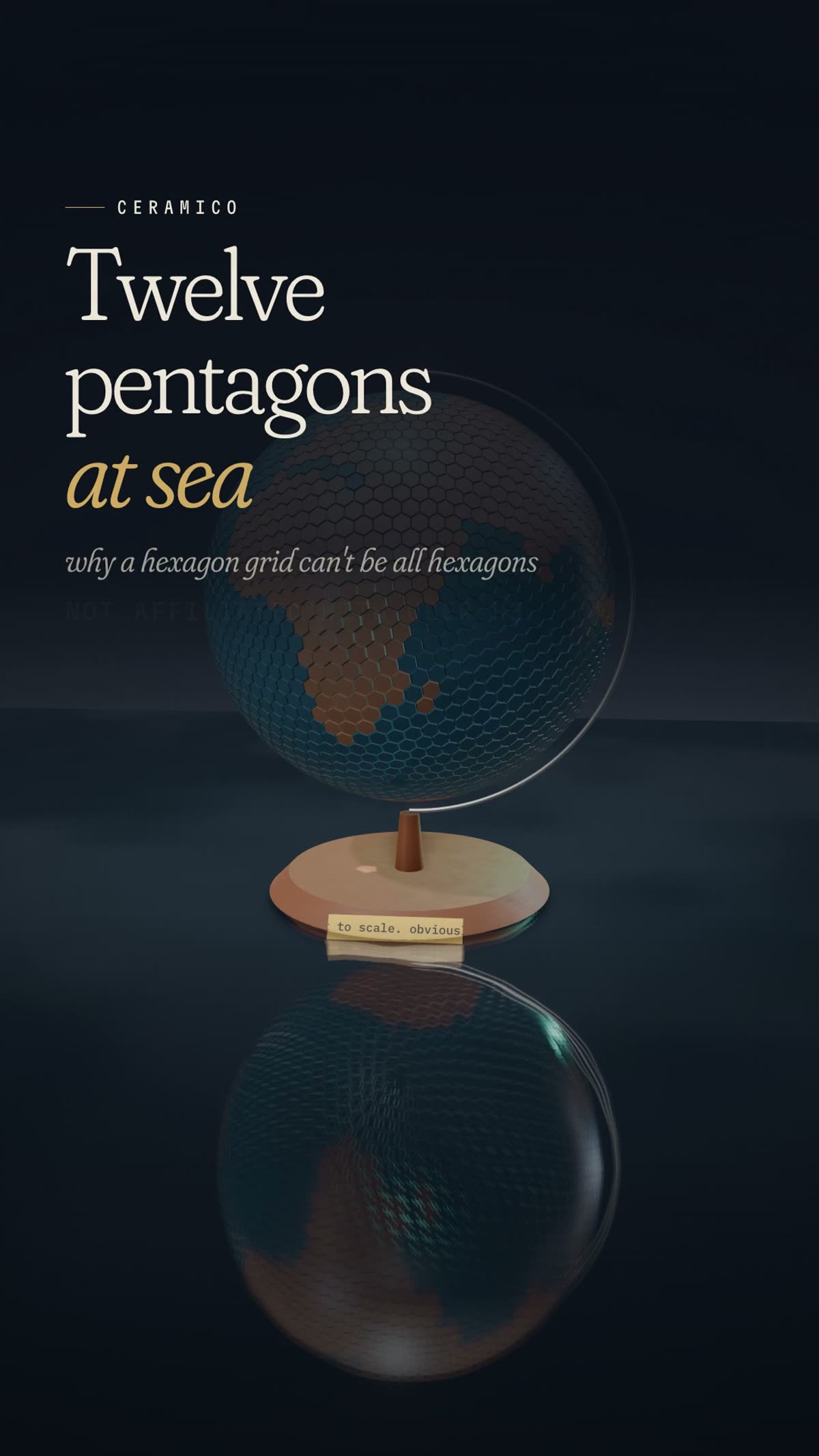 Watch the film · 1:12
Somewhere in the Norwegian Sea, there is a point where Uber’s map of the world stops being made of hexagons. There are eleven more like it.
Uber calls its global grid H3. The project’s own documentation describes it in one line: a geospatial indexing system that partitions the world into hexagonal cells. It was developed, the documentation says, to address the challenges of Uber’s data science needs, and the company opened it to everyone. Today it lives on GitHub as an open-source project under the Apache 2 license, still maintained, with a new release as recently as May 2026.
Our film opens on a porcelain globe glazed entirely in hexagons, which is how H3 is usually pictured. That picture is very nearly true. The interesting part is the “nearly.”
By the numbers
- Grid resolutions
- 16 0 to 15
- Cells at the coarsest resolution
- 122 110 hexagons, 12 pentagons
- Pentagons at every resolution
- 12
- Children of each hexagon
- 7 pentagons have 6
- Average hexagon at the finest resolution
- 0.895 m²
- Area of a coarsest-resolution pentagon
- about 2.56 million km²
- Faces of the icosahedron
- 20
Cell counts and areas are from the H3 project’s published tables of cell statistics across resolutions.
Prices by the hexagon
Why would a ride-hailing company want to carve the planet into tiles at all? In a 2018 post on its engineering blog introducing H3, Uber explained that it calculated surge pricing by measuring supply and demand in hexagons in each city it served. Riders and drivers each fall inside a tile, and tiles can be compared with one another.
The same post said Uber used H3 as the grid system for analysis and optimization throughout its marketplaces. That is the most recent statement of its own use that we could find. We found no later Uber source saying whether surge pricing still works this way, so we are describing what Uber said in 2018, not what it does today.
Why hexagons
The choice of shape is the clever bit, and it comes down to neighbors. On a grid of squares, a tile has two kinds of neighbor: the ones that share a side, and the ones that touch only at a corner, which sit farther away. Uber’s post notes that squares give two different distances to their neighbors, and triangles three. A hexagon has only one. Every neighbor’s center is the same distance from your own.
Uber said that mattered because people in a city are often in motion. The company said hexagons minimize the error introduced when users move through a city.
A small honesty note on that equal distance: it holds perfectly for a flat sheet of identical hexagons, which is what our film shows. On the real, round Earth, H3’s cells are not all identical. Its own statistics show that at one resolution the largest hexagons can be close to twice the area of the smallest, so the spacing between centers varies slightly from place to place.
The film · 1:12
Twelve Pentagons at Sea
A porcelain globe crackle-glazed into hexagons turns slowly, until a twenty-sided die settles over it and twelve gold pentagons come to rest in the ocean.
Watch more on Instagram Follow CERAMICO
Read the transcript
Uber built a grid that covers the whole planet in hexagons. In 2018, Uber said it calculated surge pricing from supply and demand in each hexagon. It comes down to one handy shape, and one problem it can't solve. On a square grid, your neighbours sit at two different distances. On a hexagon grid, every neighbour's centre is the same distance away. Uber said that matters, because people in a city are often on the move. To flatten the round Earth, H3 wraps it in a 20-sided shape, like a game die. Each face gets hexagons, and each hexagon splits into seven smaller ones that nearly fit. But you can't tile that shape with hexagons alone. So H3 hides 12 pentagons. One sits at each corner of the 20-sided shape, at every size. And H3 borrows Buckminster Fuller's tilt, which puts all twelve corners in the ocean. So Uber's grid is all hexagons, except twelve pentagons, each centred out at sea.
Animated model, illustrative and not to scale.
Wrapping a planet in a twenty-sided die
Hexagons tile a flat floor beautifully. A sphere is another matter. So H3 starts by turning the round Earth into something with flat faces. In the words of its overview, “The hexagonal grid system is created on the planar faces of a sphere-circumscribed icosahedron.”
An icosahedron is a solid with 20 triangular faces, the same shape as a twenty-sided game die. Imagine one sitting snugly around the globe. Uber’s blog explains that it used gnomonic projections centered on each face to carry the map onto those flat triangles. Each face then gets its own patch of hexagons.
Those hexagons nest. Each one splits into seven smaller children, and those into seven more, through 16 resolutions in all. The coarsest has 122 cells covering the planet; at the finest, a hexagon averages 0.895 square meters. The count of seven is exact, but the fit is not, because hexagons cannot be perfectly cut into seven smaller hexagons. H3’s documentation puts the trade-off neatly: “While geographic containment is approximate, logical containment in the index is exact.” The children overhang their parent’s edges a little, but the index always knows whose child is whose.
The count of seven is exact, but the fit is not.
The twelve exceptions
And here is the problem the shape cannot solve. You cannot tile an icosahedron with hexagons alone. Something has to give at its 12 corners. Uber’s answer, in its blog, was to introduce twelve pentagons, one at each of the icosahedron’s vertices.
They are not a one-off. H3’s overview says an icosahedral hexagon grid “must contain exactly 12 pentagons at every resolution,” and its tables confirm a dozen at every level from the coarsest to the finest. Of the 122 cells at the top level, 110 are hexagons and 12 are pentagons. Pentagons even breed differently: a hexagon has seven children, while a pentagon has six, five hexagons and one pentagon.
So where do you put twelve unavoidable imperfections? H3 did not invent an answer. It borrowed one. Its documentation says the icosahedron is fixed relative to the sphere using a Dymaxion orientation, due to R. Buckminster Fuller. And that particular tilt has a happy property. In H3’s words: “This orientation of a spherical icosahedron places all 12 icosahedron vertices in the ocean.”
Working from the face-center coordinates published in H3’s open-source code, we placed the twelve vertices ourselves. All twelve are in water, though two are close to land: one in the Yellow Sea, off China’s Liaodong Peninsula, and one in the Norwegian Sea, off Norway.
One last precision. It is the pentagons’ centers that sit at sea, not necessarily the whole tile. At the coarsest resolution, a single pentagon covers about 2.56 million square kilometers, far too big to stay offshore. At finer resolutions they shrink with everything else, and there are still exactly twelve.
Which leaves a grid that is all hexagons, except for twelve pentagons, each centered out at sea. Geometry demanded the flaw. A tilt borrowed from Buckminster Fuller found it somewhere to go.
Sources
Every line in the film was checked against these sources by an independent fact-checker before publication. Company claims are attributed to the company that made them.
Updates and corrections
- First published.
See an error? Tell us. We correct promptly and say what changed. Our corrections policy.
Disclosure
This is an independent explainer. CERAMICO is not affiliated with, sponsored by, or speaking for any company, brand, agency or person named in this story, and nothing here is official.
Claims are attributed. Where a figure or description comes from a company or an expert, we say so. CERAMICO is not affiliated with, or endorsed by, Uber. Brand names identify the company only. H3 is an open-source project released under the Apache 2 license. The animation is an illustrative model, not to scale.
Animations are illustrative. Our films use clay-style 3D models. They are not to scale and are simplified to show how something works.
Trademarks and product names belong to their owners and are used only to identify what we are describing.
Keep reading

Sticky only at the dots: the weak glue behind the Post-it Note, and why letting go is the point
Most glue tries to grab as much surface as it can. The adhesive Spencer Silver invented at 3M did the opposite, and it took years for anyone to see why that was useful.

Hit the 57: the physics of ketchup, and why Heinz wants you to tap the neck
Ketchup sits in the bottle like a soft solid until something pushes it past a limit. Heinz says the push belongs on the 57. A physicist says the bottom. Both are chasing the same number.
Why the light is green: how an Apple Watch reads your pulse through your skin
The green flicker under your watch is a tiny optics experiment, repeated hundreds of times a second. Its color comes down to a simple fact about blood.