Science · How it works
Hit the 57: the physics of ketchup, and why Heinz wants you to tap the neck
Ketchup sits in the bottle like a soft solid until something pushes it past a limit. Heinz says the push belongs on the 57. A physicist says the bottom. Both are chasing the same number.
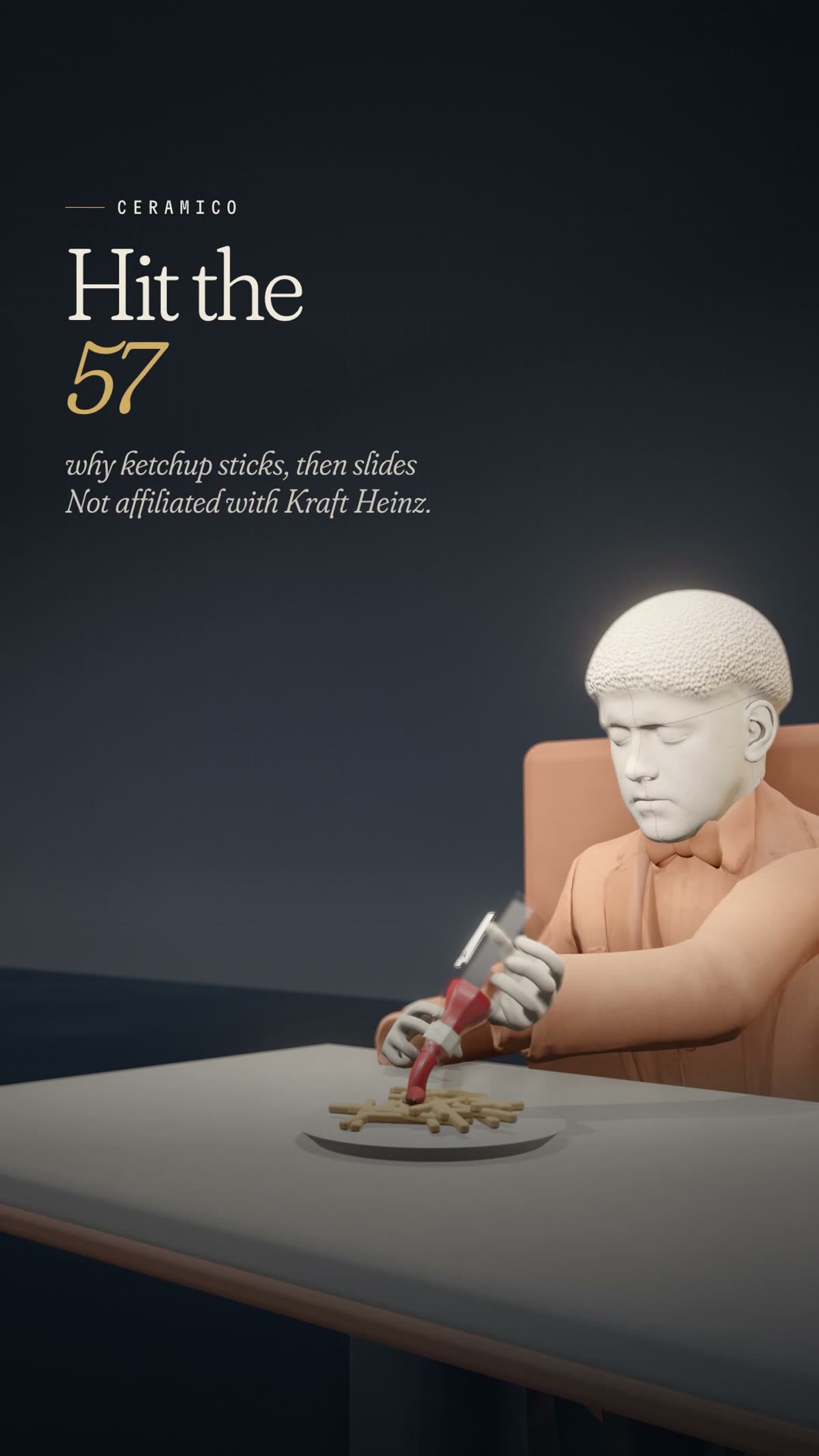 Watch the film · 1:08
Tilt a glass Heinz bottle over your fries and, very often, nothing happens. Heinz has an answer embossed right there in the glass: a small 57.
The number sits at the base of the bottle’s neck, and according to Kraft Heinz it is there for a reason. “On the iconic glass bottle, the engraving is intended to be the perfect spot to hit,” the company said in a 2019 press release. A Heinz spokesperson put the method plainly to TODAY in 2017: “apply a firm tap where the bottle narrows, and the ketchup will come out easier.”
That advice makes more sense once you know what ketchup actually is. It is not quite a liquid, and the reason it sulks in the bottle is the same reason a tap can coax it out.
By the numbers
- Heinz Tomato Ketchup first sold
- 1876
- Products Heinz sold by 1896
- over 60
- Heinz’s stated top pour speed
- 0.028 mph
- That speed, per hour
- about 45 meters
- Heinz upside-down squeeze bottle
- 2002
- Classic valve opening pressure (1995 patent)
- 25 to 28 inches of water
- Recyclable valve in North America
- 2021
The 0.028 mph figure is Heinz’s own, with no published test method. The valve pressure comes from a 1995 dispensing-valve patent, not a Heinz specification.
A sauce that acts like a soft solid
Left alone, ketchup holds its shape. Stir it, squeeze it or shake it and it pours. Food scientists call the threshold between those two states the yield stress: below it, the sauce stays put; push past it, and it flows.
The tomato is responsible. Ketchup is a suspension of tomato particles in liquid, and those particles form a loose network that resists gentle forces. A 2008 study of tomato pastes and ketchups found that the volume of solids was a good predictor of how they flow, and a 2009 study in the International Journal of Food Science & Technology found that thickeners raised ketchup’s yield point. In June 2026, the University of Chicago and Argonne National Laboratory described new work on how particle interactions control this behavior. As an Argonne physicist put it: “Yielding is the transition from solid-like behavior to liquid-like behavior.”
How solid is solid-like? Anthony Stickland, a rheologist at the University of Melbourne, has said that ketchup “prefers to be in the bottle because it is technically a solid, not a liquid.” Not every expert would go that far. In 1985, two rheologists published a paper titled “The yield stress myth?”, and later work describes such materials creeping very slowly even below their apparent yield point. “Acts like a soft solid” is the safer description, and for anyone holding a bottle, it is the one that matters.
Once ketchup does start to move, a second property kicks in. It is shear thinning: the harder it is pushed, the runnier it gets. In Stickland’s words, “this sauce is shear thinning, so it flows more easily the greater the ‘encouragement.’” So ketchup is stubborn twice over. It refuses to move until pushed past a limit, then rushes once it has.
Why the neck, according to Heinz
Heinz’s logic rests on geometry. The neck is where the bottle narrows, and that is where the ketchup tends to sit like a plug when the bottle is tipped. A firm tap there delivers a sudden jolt to the stuck sauce, enough to push it past its yield stress. The plug starts to slide, shear thinning takes over, and out it comes.
Heinz is not the only authority with an opinion, though, and the experts do not agree. Stickland’s advice is to hold the bottle at “an angle of around 45 degrees” and give “gentle but firm taps on the bottom of the bottle.” Smithsonian’s write-up of his method ran the subhead “Tapping the ‘57’ has nothing to do with it.” A 2013 Gizmodo history took Heinz’s side, arguing that the bottom is not the best place to thump. Wherever you tap, the goal is the same: get the sauce past its limit.
So ketchup is stubborn twice over. It refuses to move until pushed past a limit, then rushes once it has.
Heinz also says how fast the result should be. Its 2019 release promised ketchup “pouring out at top speed: 0.028 miles per hour,” and the company repeated the figure in a 2023 campaign in the Middle East. Heinz has not published how it measures that, so it is best treated as a company claim. Converted, it comes to about 45 meters an hour, which is less than the 50 meters of one Olympic pool length. Rushing, for ketchup, is relative.
The film · 1:08
Hit the 57
A clay-animated look at why ketchup sticks in a glass Heinz bottle, why Heinz says to tap the 57, and how the old upside-down cap’s valve behaved like the sauce.
Watch more on Instagram Follow CERAMICO
Read the transcript
The 57 on a Heinz glass bottle isn't just a slogan. It's a target. Heinz says tap it there. Why the neck? At rest, ketchup acts like a soft solid. Tomato bits hold together, so it won't pour until pushed past a limit: the yield stress. But once it moves, it gets runnier the harder you push. That's shear thinning. Oh, and 57 was never a count. Heinz already sold over 60 products. Heinz’s logic: the neck is where the bottle narrows, and the ketchup jams. A firm tap jolts it past the limit. It slides. Heinz says top speed is 0.028 miles an hour. Under one Olympic pool length an hour. Upside-down bottles cheat: for years, their Heinz caps hid a silicone valve. Gravity alone can't open it. Squeeze, it snaps open. Let go, it snaps shut. The valve mimics the ketchup: solid, until pushed past the limit. Send this to anyone still stuck waiting. So next time, aim for...
Animated model, illustrative and not to scale.
The 57 was never a count
The number on the neck has its own backstory, and it has nothing to do with physics. Heinz Tomato Ketchup dates to 1876, and according to Heinz, “By 1896, he sold over 60 products.” The company says founder Henry Heinz spotted a shoe company advertising 21 styles of shoe and was inspired to coin his “57 varieties” slogan.
Why 57, when the true number was higher? Heinz itself admits: “Why 57? No one knows for sure.” The Senator John Heinz History Center says he stopped at 57 “because he liked the way it sounded.” CNN, revisiting the story in 2022, was blunt: “There weren’t 57 Heinz varieties” when the slogan was invented. The number was marketing from the start. It just happened, later on, to become a target.
The valve that behaved like ketchup
Plastic bottles took a different route around the problem. Heinz introduced a squeezable plastic bottle in 1983, and in 2002 an upside-down bottle that stands on its cap. A 2002 trade report described the upside-down design as having “a patented silicone valve” to direct the ketchup.
Valves of this kind were already well established. A Procter & Gamble patent, filed in 1984 and granted in 1988, describes a self-sealing elastomer valve that stays closed below a chosen pressure, so the package can be “stored inverted” without leaking. A later dispensing-valve patent, granted in 1995, spells out the principle: the pressure needed to open the valve is greater than the weight of the contents pressing on it. Gravity alone cannot open it. In that design, the valve’s cross-shaped slit “snaps open” at a pressure of roughly 25 to 28 inches of water, a modest squeeze, and closes again “with a snapping action” when you let go. No public source ties Heinz’s own cap to a specific patent, but the principle is the same.
Look at what that valve does and it is a familiar story: it stays solid until pushed past a limit, then gives way. The cap was, in effect, imitating the sauce.
In two big markets, that silicone valve is now history. In North America, Heinz Ketchup began moving in 2021 to Aptar’s recyclable SimpliCycle valve, made of a low-density material. In the United Kingdom, Heinz switched in 2023 to a cap made from a single type of plastic, polypropylene. “The old-style Heinz cap used a flexible valve made from silicone, which was a challenge to recycle,” a Kraft Heinz executive explained at the time.
The glass bottle, meanwhile, still carries its 57. Whether you follow Heinz and tap the neck or follow the physicist and tap the bottom, you are doing the same thing: giving a soft solid the push it has been waiting for.
Sources
Every line in the film was checked against these sources by an independent fact-checker before publication. Company claims are attributed to the company that made them.
- International Journal of Food Science & Technology: Rheological properties of ketchup (2009)
- Aptar: Standing out on the shelf, closures customer success stories
- Campaign Middle East: Heinz unveils world’s first ketchup racetrack ramp (2023)
- Wikimedia Commons: H. J. Heinz Company logo
- Wikimedia Commons: Heinz logo
- Wikimedia Commons: Heinz logo (1969)
- Wikimedia Commons: Ketchup bottles (photo)
- Wikipedia: Olympic-size swimming pool
- Futurity: Getting ketchup out of the bottle (2016)
- Gizmodo: The untold history behind everyone’s favorite condiment (2013)
- CNN Business via KTVZ: Heinz made up its famous number 57 (2022)
- Rheologica Acta: The yield stress myth? (Barnes and Walters, 1985)
- Kraft Heinz newsroom
- Kraft Heinz: HEINZ relishes 150 years (2019)
- University of Chicago: How particle interactions control flow in soft materials like ketchup (2026)
- Google Patents: US 4,728,006, flexible container with self-sealing valve (Procter & Gamble)
- Google Patents: US 4,991,745, dispensing valve with trampoline-like construction
- Google Patents: US 5,377,877, dispensing valve for packaging
- University of Melbourne Pursuit: Getting tomato sauce out of the bottle, minus the mess
- Barnes: A review of the yield stress (1999, PDF)
- BakeryandSnacks: Heinz and Conagra launch new ketchup packaging (2002)
- FoodTechBiz: Aptar launches SimpliCycle valve in Kraft Heinz packaging (2021)
- Futurity: Getting ketchup out of the bottle (2016, www)
- Heinz: Our story
- Heinz History Center: Heinz mottoes and 57 Varieties (2019)
- Lund University: Bayod, Pilman Willers and Tornberg, tomato pastes and ketchups (2008)
- Packaging Europe: Iconic packs, Heinz ketchup bottle (2026)
- Packaging World: Heinz Ketchup selects Aptar SimpliCycle dispensing valve
- Refinery29: The Heinz ketchup bottle trick (2016)
- U.S. SEC: AptarGroup Form 10-K, fiscal 1997
- U.S. SEC: AptarGroup Form S-3/A (1998)
- Smithsonian: Physicist has figured out the best way to get ketchup out of the bottle (2017)
- Snopes: 57 Varieties
- Sustainability Beat: Heinz recyclable cap (2023)
- Tasting Table: The purpose of the 57 on Heinz bottles (2026)
- TODAY: The sweet spot to tap on a Heinz bottle (2017)
Updates and corrections
- First published.
See an error? Tell us. We correct promptly and say what changed. Our corrections policy.
Disclosure
This is an independent explainer. CERAMICO is not affiliated with, sponsored by, or speaking for any company, brand, agency or person named in this story, and nothing here is official.
Claims are attributed. Where a figure or description comes from a company or an expert, we say so. CERAMICO is not affiliated with Kraft Heinz. Brand names identify the product only. Tapping the 57 is Heinz’s advice, not settled physics. The animation is an illustrative model, not to scale.
Animations are illustrative. Our films use clay-style 3D models. They are not to scale and are simplified to show how something works.
Trademarks and product names belong to their owners and are used only to identify what we are describing.
Keep reading

Sticky only at the dots: the weak glue behind the Post-it Note, and why letting go is the point
Most glue tries to grab as much surface as it can. The adhesive Spencer Silver invented at 3M did the opposite, and it took years for anyone to see why that was useful.
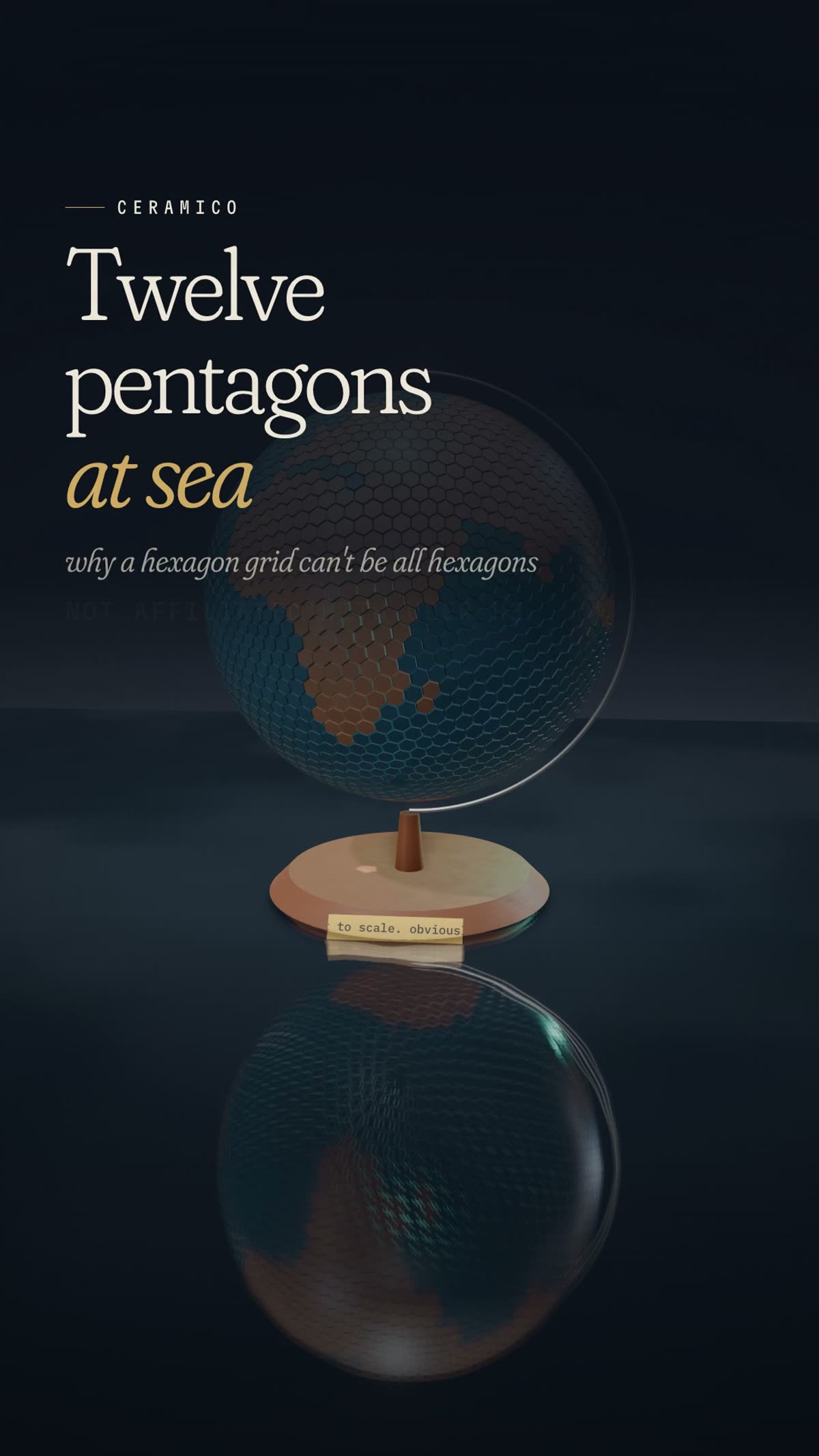
Twelve pentagons at sea: the hidden flaw in Uber’s hexagon map of the world
Uber built a grid that tiles the planet in hexagons. Geometry would not allow it to be all hexagons, so the twelve exceptions were tucked away where hardly anyone would notice: out at sea.
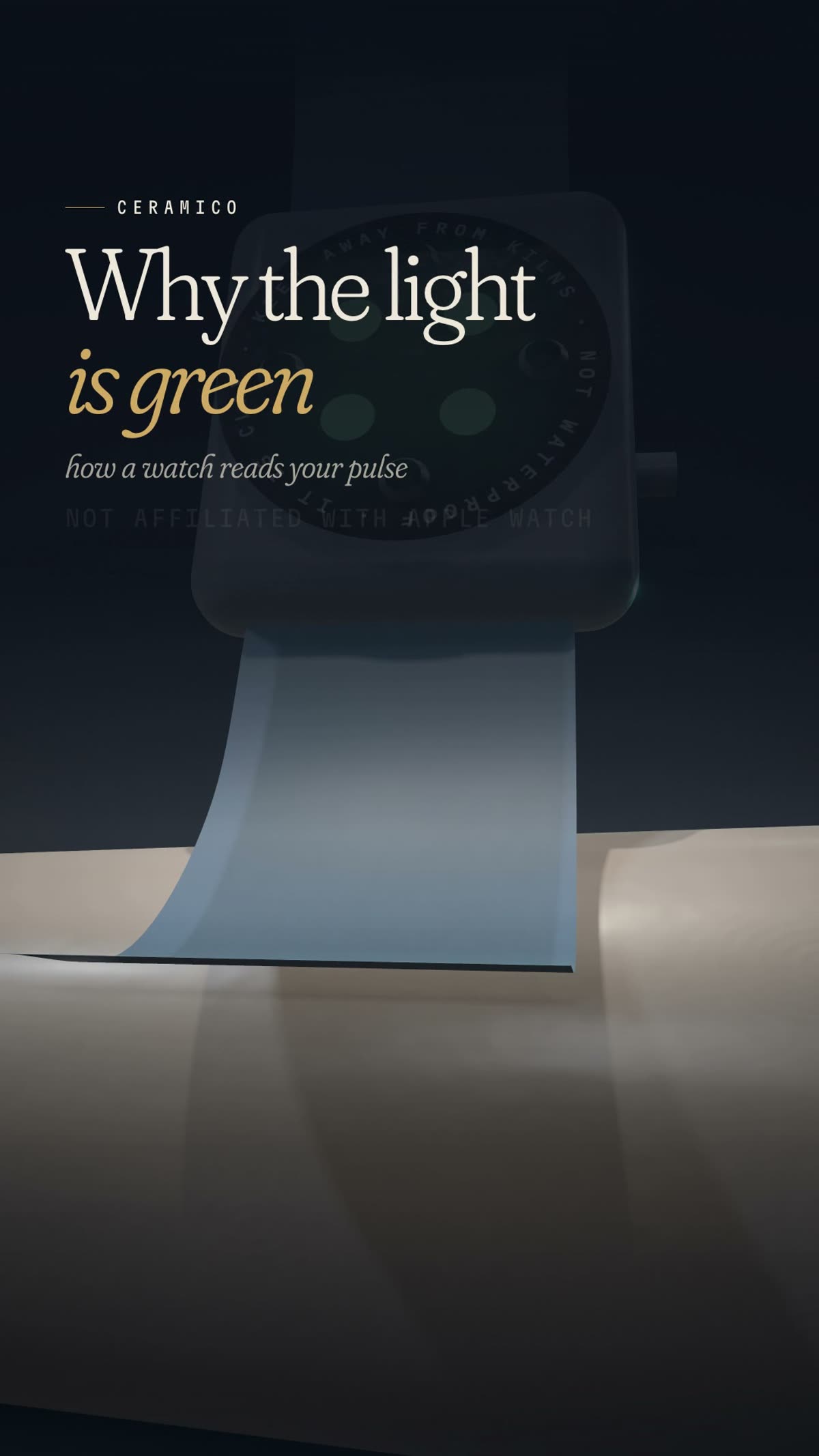
Why the light is green: how an Apple Watch reads your pulse through your skin
The green flicker under your watch is a tiny optics experiment, repeated hundreds of times a second. Its color comes down to a simple fact about blood.