Science · How it works
Why the light is green: how an Apple Watch reads your pulse through your skin
The green flicker under your watch is a tiny optics experiment, repeated hundreds of times a second. Its color comes down to a simple fact about blood.
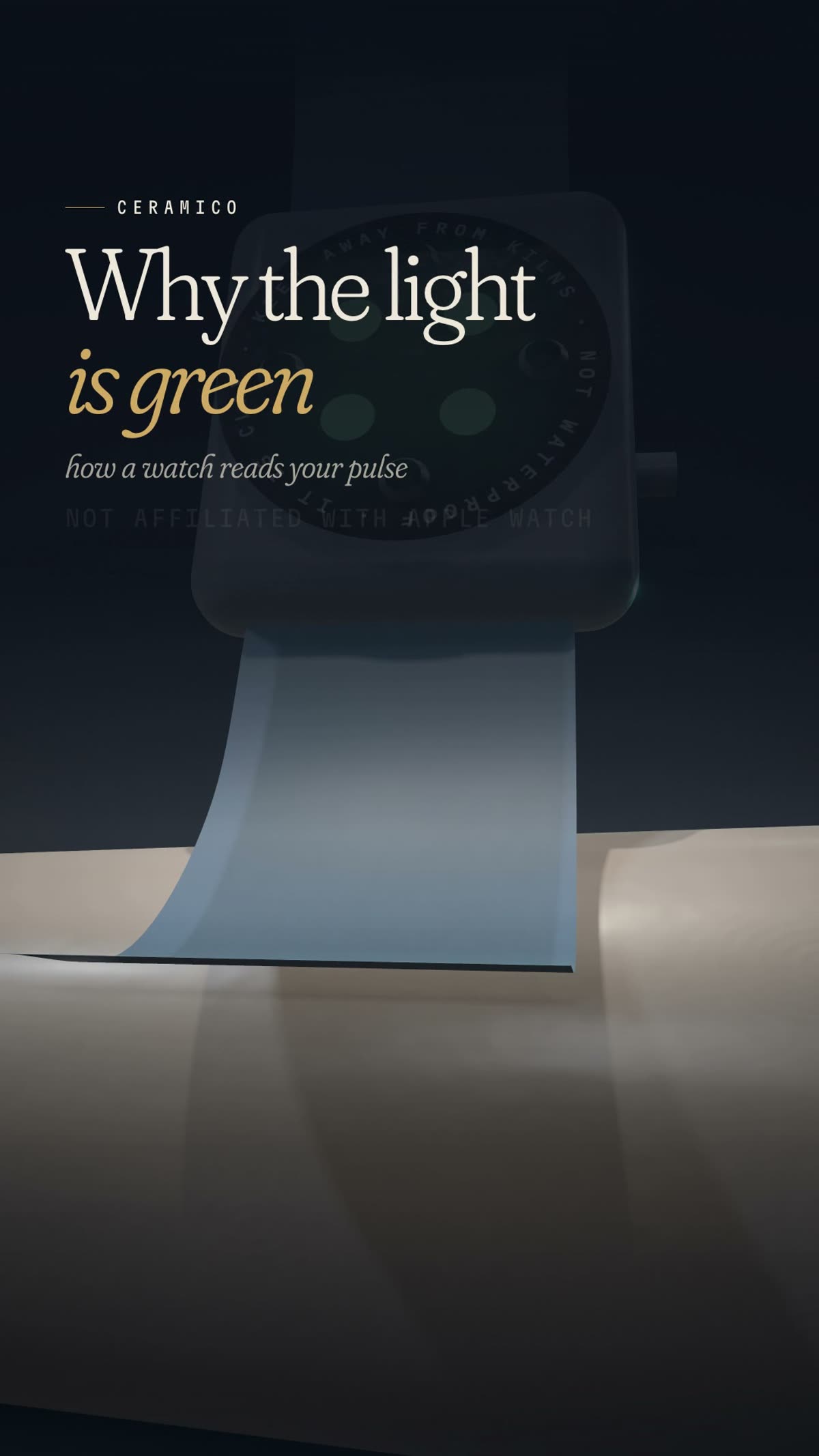 Watch the film · 1:00
Take off an Apple Watch in a dim room and you may catch it: a green glow on the underside, flickering far too fast to follow.
That flicker is the watch taking your pulse. Apple says its optical heart sensor can flash its LED lights hundreds of times per second, and that this is how it calculates the number of times your heart beats each minute. The whole measurement is light going into your wrist and some of it coming back.
The technique has a name that Apple itself admits is a mouthful: photoplethysmography, or PPG. But the company also says the technology is “based on a very simple fact,” and the fact is about the color of blood.
By the numbers
- Flash rate
- hundreds of times per second
- Readings on Series 12 and Ultra 4
- as often as every 5 seconds, during the day
- Light at night (sleep schedule)
- infrared
- Oxyhemoglobin absorption, green vs red
- about 125× 530 nm vs 660 nm
- Deoxyhemoglobin absorption, green vs red
- about 12×
- Oxyhemoglobin absorption, blue vs green
- about 13× 414 nm vs 530 nm
Flash rate and sampling behavior are Apple’s statements. Absorption ratios are worked out from the tabulated molar extinction coefficients for hemoglobin published by the Oregon Medical Laser Center.
A strobe on your wrist
Turn the watch over and you will find two kinds of parts. Apple describes green LED lights “paired with light-sensitive photodiodes,” tiny light sensors. The lights shine down into the skin. The photodiodes sit beside them and catch whatever finds its way back.
The exact layout differs from model to model. When Apple introduced Series 6 in 2020, for example, it described clusters of LEDs and four photodiodes on the back crystal. So does the color. Apple says the color of LED a watch uses for sampling depends on several factors, “such as your watch model, your activity level, and whether you’re sleeping.” Its current support page says infrared LEDs are used during your sleep schedule. On Series 12 and Ultra 4, green LEDs run continuously during the day, providing a measurement as often as every five seconds.
That is why our film says the watch can flash green hundreds of times a second, rather than that it always does. The green strobe is the daytime workhorse, not the whole story.
The film · 1:00
Why the Light Is Green
A clay wrist opens into a porcelain cross-section, where green light dives toward a pulsing vessel and the watch counts what comes back.
Watch more on Instagram Follow CERAMICO
Read the transcript
Your Apple Watch can flash its green lights hundreds of times a second. Apple says that's how it measures your heart rate, right through your skin. And the reason it's green is hiding in your blood. Beside the lights sit tiny light sensors, called photodiodes. The green light shines into your wrist, and some of it scatters back out. Each heartbeat squeezes a little extra blood into your wrist. More blood soaks up more green, so less light makes it back. Between beats, the flow eases, and a little more green returns. Why green? Apple says blood looks red because it reflects red and absorbs green. So the watch counts the dips in green, and that's your heart rate. If the signal's faint, Apple says it turns the lights up and samples faster. Red blood, green light. That's the simple idea behind those green flashes.
Animated model, illustrative and not to scale.
Counting with light
Follow a single burst of green into the wrist. Some of it is absorbed by the tissue. Some of it scatters around and makes its way back out to the photodiodes. An Apple patent describing PPG systems in general puts it this way: a light source injects light into the user’s tissue, and a light detector receives light that reflects or scatters and exits the tissue.
Now add a heartbeat. Each beat squeezes a little extra blood into your wrist. Apple’s support page explains that when your heart beats, the blood flow in your wrist is greater, and so is the green light absorption. Between beats, it is less.
The physics underneath is about volume. The patent describes the PPG signal as the amplitude of reflected and scattered light, modulated by changes in blood volume in the tissue. A review of wearable PPG sensors makes the same point: “The reflected light is proportional to blood volume variations.” More blood in the light’s path soaks up more green, so less light makes it back. Between beats, a little more green returns.
So the photodiodes see a faint, rhythmic dimming and brightening, one dip per heartbeat. The watch turns that rhythm into a heart rate. Apple has not published its algorithm, so “counts the dips,” as our film puts it, is a plain-language description rather than a literal one. And if the signal is weak, Apple says the sensor is “designed to compensate for low signal levels by increasing both LED brightness and sampling rate.”
More blood in the light’s path soaks up more green, so less light makes it back.
Why green, and not red or blue
Here is the simple fact Apple was talking about. In its words: “Blood is red because it reflects red light and absorbs green light.” Strictly, blood looks red because red is the light it absorbs least and sends back to your eye. Green, it swallows readily.
The numbers bear that out, and dramatically. Tabulated measurements for hemoglobin show that oxygen-rich hemoglobin absorbs roughly 125 times more strongly at a green wavelength of 530 nanometers than at a red one of 660 nanometers. For hemoglobin without its oxygen, the gap is smaller but still about twelvefold. Shine green into a wrist and every extra pulse of blood makes a noticeable dent in what comes back.
But there is a twist. Green is not the color blood absorbs most. Blue is absorbed even more strongly: at 414 nanometers, oxygen-rich hemoglobin absorbs about 13 times more than at green. So why not use blue? Because light has to get far enough into the skin to reach the blood in the first place. A 2019 review of PPG by T. Tamura sums up the balance: “Hemoglobin absorbs green light better than red light and penetrates deeper than blue light.” Green is the compromise, absorbed strongly enough to show each heartbeat, and penetrating deep enough to find it.
What the simple idea leaves out
Our film ends on “Red blood, green light,” and calls it the simple idea behind the flashes, which is how Apple frames it too. The full picture is messier, in a few honest ways.
First, the science is not completely settled. The textbook model, which Apple follows, says the green signal comes from pulses of blood volume. A 2015 paper in Scientific Reports by Kamshilin and colleagues proposed a different view: that pressure pulses in the arteries deform the connective tissue of the skin, and that this contributes to what the sensor sees. The mainstream model remains the standard explanation, but researchers are still arguing over the details.
Second, a good reading depends on more than color. Fit, motion and skin all play a part, and the watch adjusts its LEDs and sampling when the signal is weak. Apple is candid that the method has limits: “for a small percentage of users, various factors may make it impossible to get any heart rate reading at all.”
None of that undoes the elegance of the core trick. Blood drinks green light. Each heartbeat brings a little more blood, and a little less green comes home. Count the rhythm of those small shortfalls and you have a pulse, read straight through the skin by a flicker most people never notice.
Sources
Every line in the film was checked against these sources by an independent fact-checker before publication. Company claims are attributed to the company that made them.
- Apple Support: Monitor your heart rate with Apple Watch
- Apple Newsroom: Apple Watch Series 6 delivers breakthrough wellness and fitness capabilities (2020)
- Google Patents: US11559216B1, Integrated photodiode (Apple Inc.)
- OMLC: Tabulated molar extinction coefficient for hemoglobin in water
- Tamura, Biomedical Engineering Letters (2019): Current progress of photoplethysmography and SpO2 for health monitoring
- Castaneda et al. (2018): A review on wearable photoplethysmography sensors
- Kamshilin et al., Scientific Reports (2015): A new look at the essence of the imaging photoplethysmography
Updates and corrections
- First published.
See an error? Tell us. We correct promptly and say what changed. Our corrections policy.
Disclosure
This is an independent explainer. CERAMICO is not affiliated with, sponsored by, or speaking for any company, brand, agency or person named in this story, and nothing here is official.
Claims are attributed. Where a figure or description comes from a company or an expert, we say so. CERAMICO is not affiliated with, or endorsed by, Apple. Brand names identify the product only. This article explains how the sensor works and is not medical advice. The animation is an illustrative model, not to scale.
Animations are illustrative. Our films use clay-style 3D models. They are not to scale and are simplified to show how something works.
Trademarks and product names belong to their owners and are used only to identify what we are describing.
Keep reading

Sticky only at the dots: the weak glue behind the Post-it Note, and why letting go is the point
Most glue tries to grab as much surface as it can. The adhesive Spencer Silver invented at 3M did the opposite, and it took years for anyone to see why that was useful.

Hit the 57: the physics of ketchup, and why Heinz wants you to tap the neck
Ketchup sits in the bottle like a soft solid until something pushes it past a limit. Heinz says the push belongs on the 57. A physicist says the bottom. Both are chasing the same number.

Twelve pentagons at sea: the hidden flaw in Uber’s hexagon map of the world
Uber built a grid that tiles the planet in hexagons. Geometry would not allow it to be all hexagons, so the twelve exceptions were tucked away where hardly anyone would notice: out at sea.