Science · How it works
Sticky only at the dots: the weak glue behind the Post-it Note, and why letting go is the point
Most glue tries to grab as much surface as it can. The adhesive Spencer Silver invented at 3M did the opposite, and it took years for anyone to see why that was useful.
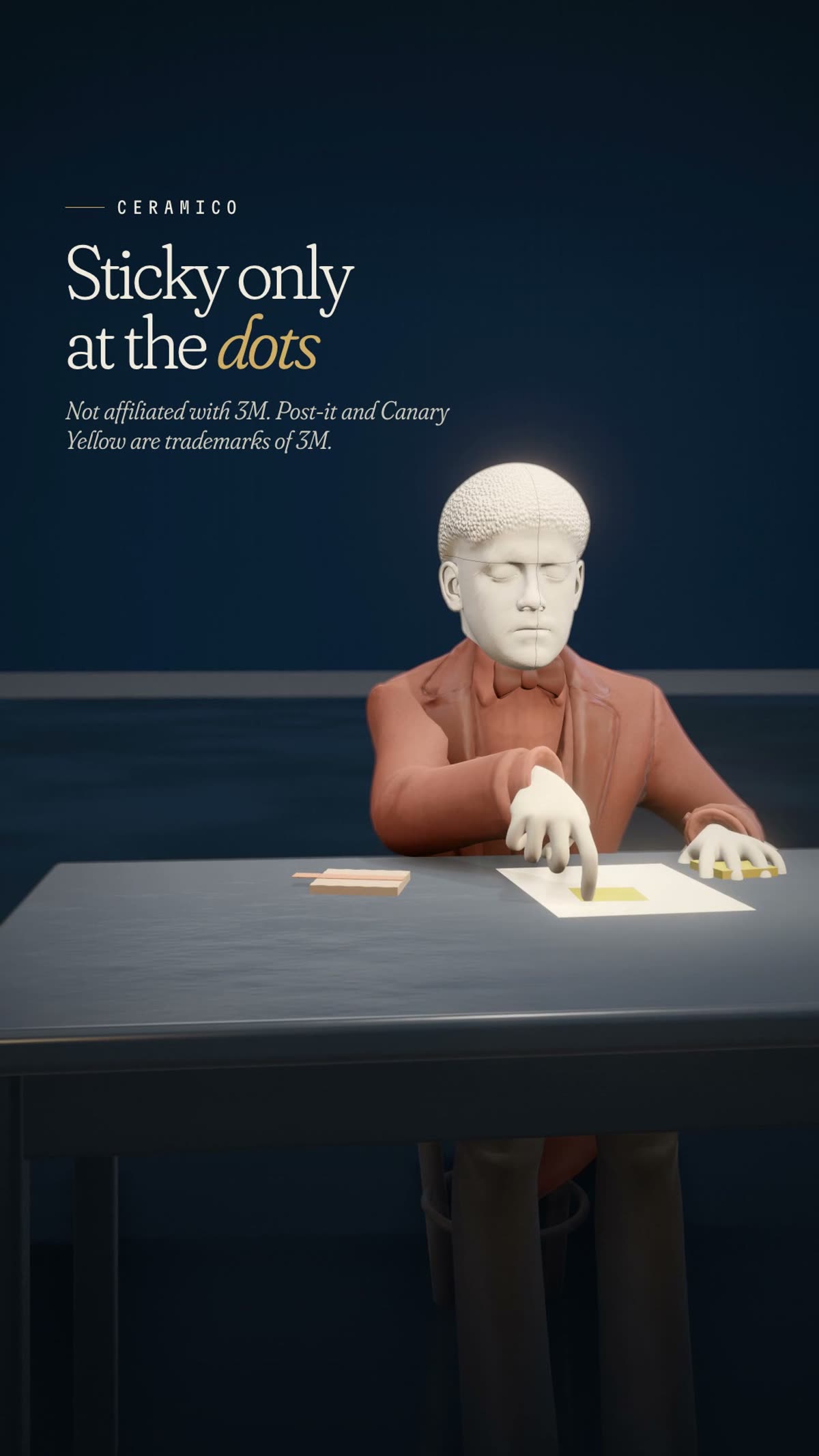 Watch the film · 1:06
A Post-it Note holds a page in place, comes away without a mark, then sticks again somewhere else. The trick is that its glue was never trying very hard.
Most adhesives are judged by how firmly they hold. The one on the back of a Post-it Note is judged by how gracefully it lets go. That reversal is the whole story: a glue that 3M’s own researchers considered too weak, years of looking for a use, and a choir singer whose bookmarks kept falling out of his hymnal.
To see how it works, it helps to start with what ordinary glue does.
By the numbers
- Silver’s low-tack glue developed
- 1968
- Microsphere patent granted
- 1972
- Most sphere diameters in Silver’s patent
- about 5 to 150 microns
- Width of a human hair, per nano.gov
- about 80 to 100 microns
- Test-marketed as Press ’n Peel
- 1977
- US launch as Post-it Notes
- April 6, 1980
- Classic note size
- 76 × 76 mm
Sphere sizes are from Spencer Silver’s 1972 patent and describe the original microsphere adhesive; 3M does not publish the formula of today’s notes. The 1977 and 1980 dates are from 3M and the Minnesota Historical Society; note size per the German Patent and Trade Mark Office.
What most glue wants
A surface that looks smooth is, close up, a landscape of tiny hills and pits. A conventional pressure-sensitive adhesive, the kind on most tape, behaves like a very thick liquid. A 1986 patent from the German company Beiersdorf describes how such an adhesive “flows also into the indentations of the substrate surface,” and notes that “the adhesivity of a whole-surface coat of contact adhesive increases with the duration of attachment.” Art Fry made the same observation in his own 3M patent: with conventional adhesives, “adhesion will frequently increase upon extended contact to a degree sufficient to cause tearing or delamination.”
That is useful when you want a parcel to stay shut. It is a nuisance when you want to move a note from your screen to your notebook. Leave tape on paper long enough and it either tears the fibers or leaves a residue behind.
A carpet of rubbery balls
The original Post-it adhesive took a different approach. Instead of a continuous film, it was a layer of tiny balls. Spencer Silver’s patent, granted in 1972, describes “inherently tacky, elastomeric copolymer microspheres,” most of them about 5 to 150 microns across. For scale, the US National Nanotechnology Initiative says a human hair is roughly 80,000 to 100,000 nanometers wide, or 80 to 100 microns. So a typical sphere is about as wide as a hair, though the sizes vary a lot.
The spheres are not packed tight. A science explainer from the Hong Kong University of Science and Technology describes “a single layer of sparsely spaced microspheres” on the paper, and they sit only in a strip along one edge of the back of the note. 3M describes the result as microspheres that “retain their stickiness but with a ‘removability characteristic,’ allowing attached surfaces to peel apart easily.”
Here is the mechanism in four moves.
Press. When you smooth the note down, each rubbery ball squashes slightly. Silver’s patent notes that “a force applied directly to one of the polymer spheres will deform it.” Each one meets the page at a small, flattened patch rather than across its whole surface. The Lemelson-MIT program at MIT puts it neatly: the spheres “would stick only where they were tangent to a given surface.” In a reply quoted on the adhesives site This to That, 3M’s Office Supplies Division says the note “sticks lightly and repositions because the microspheres limit the amount of surface area contact.” The whole note, in other words, hangs on a scatter of dots.
Peel. When you lift the note, the force does not spread out across a film. It lands on those few dots. The Beiersdorf patent describes the pull acting “concentratedly on the relatively small, circular, discrete attached flattened parts of the spheres.” Because the stress is focused there, the glue lets go at the surface of the page instead of splitting apart inside itself. Adhesive engineers call the first outcome adhesive failure and the second cohesive failure; in the patent’s words, “the desired adhesive failure is brought about preferentially, and the undesirable cohesive failure is suppressed.”
Stay. The spheres are meant to stay on the note, not on your page. Germany’s patent and trademark office, the DPMA, says the microspheres “could be removed without leaving any residue,” and 3M Canada says the repositionable adhesive “won’t mark paper.” This is the designed outcome rather than a law of nature: 3M’s own patents describe “microsphere transfer” to the other surface as a known problem, addressed with binders or primers.
Recover. Released, the spheres spring back. Silver’s patent describes them “regaining their spherical shape upon release of pressure,” which permits “separation, repositioning and rebonding of adhered objects.” That is why a note can be moved and stuck again. Not forever, though. HKUST notes that “dust and dirt accumulate onto the sticky microspheres” with use, which is why an old note eventually gives up.
The film · 1:06
Sticky Only at the Dots
A clay-style macro journey under a Post-it Note’s sticky strip, where rubbery microspheres squash, grip at tiny dots and spring back.
Watch more on Instagram Follow CERAMICO
Read the transcript
A Post-it Note barely touches the page it's stuck to. So how does it hold, then let go clean? Most glue flows into tiny bumps, and grips harder with time. But the original Post-it Note glue was a layer of rubbery balls about as wide as a hair. Press, and each ball squashes slightly, touching the page at one dot. So the whole note hangs on scattered dots. Peel, and the pull hits only those dots. They release the page, but stay on the note. Then they spring back round, ready again. 3M wanted stronger glues. In 1968, its scientist Spencer Silver made one that barely held. For years, no one found a good use. Then Art Fry kept losing bookmarks from his choir hymnal. His sticky bookmark became a note. In 1980, it hit stores nationwide. Weak was never the flaw. Letting go is the point. Send this to the friend buried in yellow squares. Next time you peel one, remember:
Animated model, illustrative and not to scale.
The glue nobody wanted
None of this was the plan. According to the National Inventors Hall of Fame, in 1968 Spencer Silver was a senior scientist developing new classes of adhesives at 3M. The goal, as Silver is quoted on 3M’s history page, was the opposite of what he found: “At that time we wanted to develop bigger, stronger, tougher adhesives. This was none of those.” What he had made, in 3M’s description, was “an adhesive that stuck lightly to surfaces but didn’t bond tightly to them.”
Weak was never the flaw; letting go was the point.
Silver believed in it anyway. “For years, Silver struggled to find a use for his invention,” 3M’s history says, and he recalled becoming known as “Mr. Persistent because I wouldn’t give up.” Uses were tried. Lemelson-MIT says Silver wanted to market it as a surface for bulletin boards, and according to a New York Times account quoted by Christianity Today, 3M introduced a Post-it Bulletin Board in the early 1970s. It collected dust and did not catch on. For years, no one found a good use.
The good use came from church. Art Fry, another 3M scientist, sang in a choir and marked his hymnal with scraps of paper. In 3M’s telling, “By Sunday, he’d find that they’d all fallen out of the hymnal.” Fry wanted a bookmark that would not fall out, and Silver’s light-tack glue offered one. (Sources disagree on the year of Fry’s idea, with the Minnesota Historical Society giving 1973 and other accounts 1974.)
The leap from bookmark to note came next. “I thought, what we have here isn’t just a bookmark,” Fry said, according to 3M. “It’s a whole new way to communicate.”
From Press ’n Peel to Post-it
The first launch did not go smoothly. 3M says it put the product on sale in four cities under the name Press ’n Peel, “with mixed results,” and the Minnesota Historical Society dates those market tests to 1977. 3M followed with what it calls the “Boise Blitz,” which the Minnesota Historical Society dates to 1978, and on April 6, 1980, according to 3M, the product “debuted in US stores as Post-it Notes.” The National Inventors Hall of Fame describes this as the national introduction in the United States.
Even the color was an accident. 3M says the Canary Yellow was “chosen by happenstance,” because a lab next door only had scrap yellow paper on hand. The classic note measures 76 by 76 millimeters, according to the DPMA, and 3M’s product pages list 100 sheets per pad.
Whether today’s notes still use the same microsphere chemistry is not something 3M states on its current product pages; the formula is proprietary, and a 2004 3M safety data sheet lists only an “acrylate adhesive.” What 3M does say, on its own history page, is that “the now famous Post-it adhesive continues to be used on many 3M products.” The company also sells stronger variants, such as Super Sticky and Extreme Notes.
Why it matters
The Post-it Note is a reminder that the right answer depends on the question. Measured against the goal of a stronger glue, Silver’s microspheres were a failure. Measured against the goal of a note you can move, they are close to ideal: strong enough to hold a sheet of paper, weak enough to let it go, and springy enough to do it again. Weak was never the flaw; letting go was the point.
The mechanism is just as neat. By breaking a continuous film into a scatter of rubbery dots, the adhesive limits its own grip. Every peel lands on a handful of tiny contact points, and every press squashes them into place again. It is engineering by restraint, and it has been sitting on desks since 1980.
Sources
Every line in the film was checked against these sources by an independent fact-checker before publication. Company claims are attributed to the company that made them.
- Google Patents: US 3,691,140, Acrylate copolymer microspheres (Silver)
- Google Patents: US 4,587,152, Residuelessly redetachable contact-adhesive sheetlike structures (Beiersdorf)
- Google Patents: US 5,194,299, Repositionable pressure-sensitive adhesive sheet material (Fry)
- Google Patents: US 5,571,617, Pressure sensitive adhesive comprising tacky surface active microspheres
- Google Patents: US 3,857,731, Acrylate microsphere-surfaced sheet material
- Google Patents: US 4,166,152, Tacky polymeric microspheres
- Google Patents: US 6,296,932, Microsphere adhesive coated article for use with coated papers
- Post-it (3M): History timeline of Post-it Notes
- 3M: Post-it Notes 654 product page
- 3M Canada: Post-it Notes 654, Canary Yellow
- 3M News Center
- DPMA: Post-it anniversary
- Lemelson-MIT: Art Fry and Spencer Silver
- National Inventors Hall of Fame: Spencer Silver
- MNopedia (Minnesota Historical Society): Post-it Notes
- HKUST Science Focus: How do sticky notes work?
- nano.gov: Just how small is nano?
- BioNumbers (Harvard): Human hair diameter
- This to That: Post-it FAQ
- Christianity Today: The Christian history of Post-its
- HISTORY: Post-it Notes debut
- Wikipedia: Spencer Silver
- Snopes: Post-it origins
- 3M material safety data sheet: Post-it Notes (2004)
- PR Times: 3M Japan Post-it SUISAI Fusen Collection release
- Wikimedia Commons: Post-it logo (2021)
- Wikimedia Commons: 3M wordmark
Updates and corrections
- First published.
See an error? Tell us. We correct promptly and say what changed. Our corrections policy.
Disclosure
This is an independent explainer. CERAMICO is not affiliated with, sponsored by, or speaking for any company, brand, agency or person named in this story, and nothing here is official.
Claims are attributed. Where a figure or description comes from a company or an expert, we say so. CERAMICO is not affiliated with 3M. Post-it and Canary Yellow are trademarks of 3M, and brand names identify the product only. The animation is an illustrative model, not to scale.
Animations are illustrative. Our films use clay-style 3D models. They are not to scale and are simplified to show how something works.
Trademarks and product names belong to their owners and are used only to identify what we are describing.
Keep reading

Hit the 57: the physics of ketchup, and why Heinz wants you to tap the neck
Ketchup sits in the bottle like a soft solid until something pushes it past a limit. Heinz says the push belongs on the 57. A physicist says the bottom. Both are chasing the same number.
Twelve pentagons at sea: the hidden flaw in Uber’s hexagon map of the world
Uber built a grid that tiles the planet in hexagons. Geometry would not allow it to be all hexagons, so the twelve exceptions were tucked away where hardly anyone would notice: out at sea.
Why the light is green: how an Apple Watch reads your pulse through your skin
The green flicker under your watch is a tiny optics experiment, repeated hundreds of times a second. Its color comes down to a simple fact about blood.