Technology · How it works
The penalty for turning left: how UPS taught its routing software to put a price on risk
UPS trucks are famous for not turning left. The truth is subtler: UPS built software that makes a left cost more, then lets the math decide.
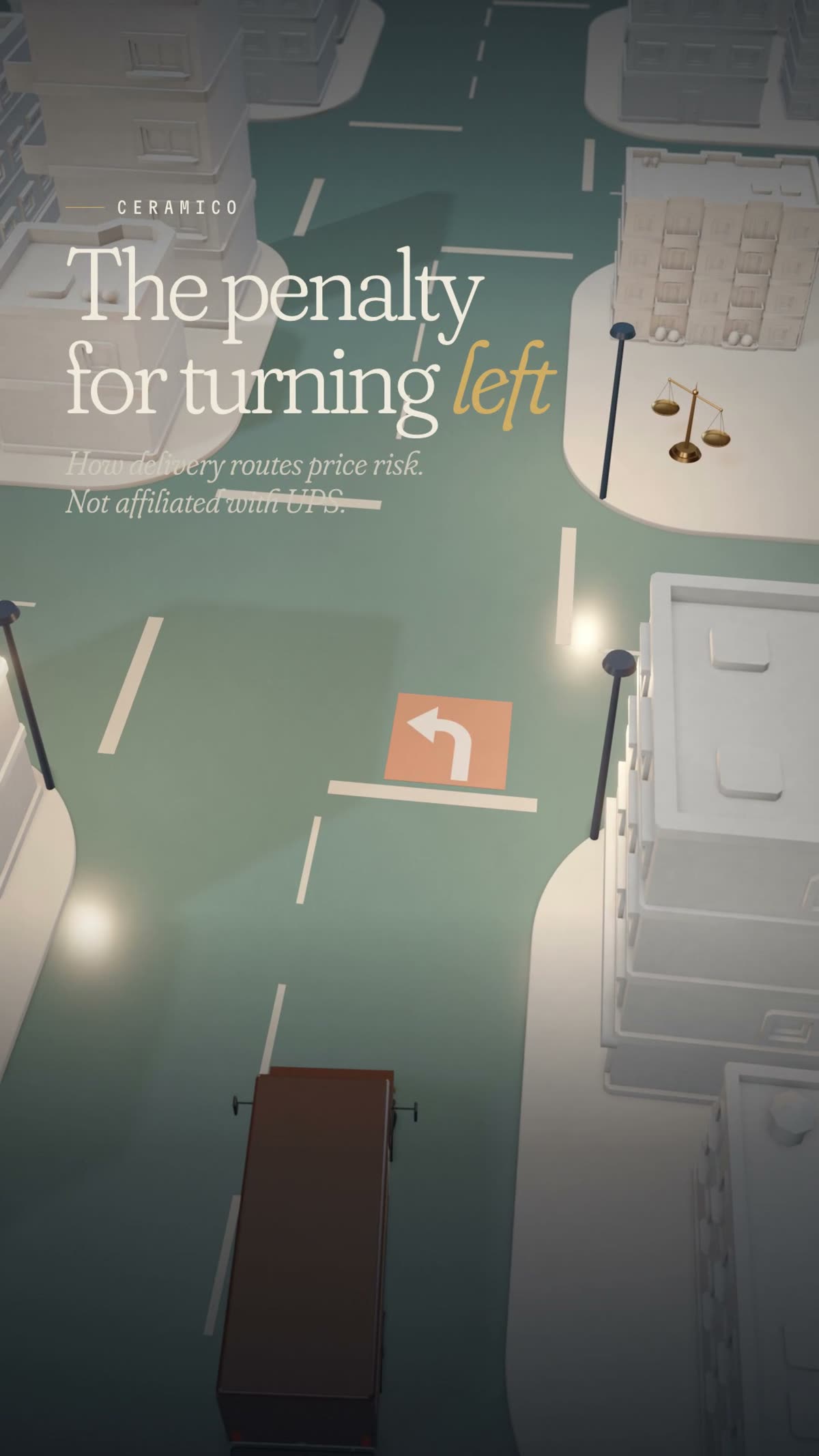 Watch the film · 1:08
Watch a brown delivery truck work a neighborhood and you may notice it favoring right turns, looping the block rather than cutting across traffic. It is not lost. It is doing the math.
The story is often told as a rule: UPS trucks never turn left. It makes a good piece of trivia and a poor description of what actually happens. UPS built routing software that puts a penalty on its trucks turning left. Not a ban. A price. And when a left turn is still the cheapest move, the truck takes it.
By the numbers
- Crashes where turning left was the critical event
- 22.2 %
- Crashes where turning right was the critical event
- 1.2 %
- ORION’s projected saving at full deployment
- 100 million miles a year
- Projected fuel saving
- 10 million gallons a year
- Projected CO₂ reduction
- 100,000 metric tons a year
- UPS US drivers routed by ORION
- 55,000
- Typical stops per driver per day
- 140 to 160
- Cost to build ORION
- 295 million US dollars
Crash shares are from NHTSA’s on-scene study of US crashes, 2005 to 2007, and are raw shares of crashes, not risk per turn. Mileage, fuel, CO₂, driver, stop and cost figures are UPS figures from a 2017 paper by its engineers; savings are projections for ORION as a whole, not left turns alone.
A puzzle with a deadline
The software is called ORION, short for On Road Integrated Optimization and Navigation. The most detailed public account of how it works comes from a 2017 paper in the journal Interfaces, written by UPS’s own engineers. According to that paper, ORION produces an optimized route for each of UPS’s 55,000 US drivers, and a typical driver serves about 140 to 160 stops a day.
The timing is tight. The engineers write that a driver’s full list of addresses for the day is known with certainty only “after the van has been loaded completely.” And the driver does not hang about: “Immediately after a van has been loaded, its driver departs the package center.” Hence, as they put it, “the routing algorithm must be extremely fast.” The engineers also put a price on dawdling: one minute of nonproductive time per driver per day, across the US network, “would cost UPS $15 million annually.”
Ordering 150 stops is a version of the travelling salesman problem, with delivery time windows added. The paper calls the problem “NP-complete,” and rather than an exact solver, ORION uses a fast metaheuristic: a method built to find good routes quickly, not provably perfect ones. UPS’s engineers are candid about this: “Some drivers can do better than ORION.”
How a left turn gets a price
Under the hood, every leg of the day has a cost. In the paper’s appendix, “the travel cost consists of the driver time and mileage costs,” and ORION tries to minimize the sum of all of them, along with wait times and penalties. A shorter, quicker hop is cheaper. A longer, slower one costs more.
Then UPS tipped the scales. The engineers write that “making left turns and zigzagging (Figure 3) on a busy street are likely to increase the probability of accidents.” Their response was not a prohibition but an adjustment: “to discourage left turns and zigzagging, we increased the objective function penalty.” Strictly, the paper applies that penalty to travel between stops that would involve unsafe behavior, not to every left turn on the map. The exact numbers are not public. UPS, the paper says, “maintains the algorithm details as a trade secret.”
Why single out the left? Part of the answer is time and fuel. A left across oncoming traffic often means sitting with the engine running, waiting for a gap. A UPS senior director of process management told CNN in 2017 that “a left-hand turn is also less fuel efficient,” and Graham Kendall, a computer scientist at the University of Nottingham, wrote in The Conversation that avoiding such turns “cuts delays caused by waiting for a gap in the traffic, which would also waste fuel.”
The other part is safety. In a federal on-scene study of US crashes from 2005 to 2007, the National Highway Traffic Safety Administration (NHTSA) found that “in the case of 22.2 percent of crashes, the critical event was turning left.” Turning right accounted for “a very small percentage (1.2%).” The critical event is the move that put a vehicle on course for a collision it could no longer avoid.
Those two figures are worth reading carefully. They are shares of all crashes in the study, not the risk of any single turn, and the study does not adjust for how often drivers turn left versus right. So they do not show that a left turn is some fixed number of times more dangerous than a right. What they do show is how often a left turn sat at the start of a crash in the study, and UPS’s engineers cite accident risk as the reason for their penalty.
The film · 1:08
The Penalty for Turning Left
A clay-style map of a delivery day, showing how UPS’s ORION software prices left turns and zigzags so routes favour loops of right turns.
Watch more on Instagram Follow CERAMICO
Read the transcript
UPS built software to put a penalty on its trucks turning left. Not a ban. A price. Here's why. Once a truck's loaded, its software, ORION, knows every stop, and must order them fast. So each hop costs miles and minutes. But left turns, and zigzags across busy streets, cost extra. Why? A left often means idling for a gap in oncoming traffic. In one federal study, left turns were the key move in 22 percent of crashes. A right? About one percent. So ORION hunts for cheaper loops: mostly rights, one side of the street, then the other. Even if they're longer. But lefts aren't banned. When one is cheapest, the truck takes it. In all, UPS expected ORION to cut 100 million miles yearly. Over 200 trips to the Moon and back. The penalty isn't a punishment. It's a price on risk. Send this to the friend who swears UPS never turns left. Next time one circles the block, remember:
Animated model, illustrative and not to scale.
Loops, not zigzags
Once lefts and zigzags carry a surcharge, a different kind of route starts to win. According to the Interfaces paper, UPS drivers are trained to deliver to customers on one side of a route first and then the other side, and “ORION builds routes that follow the UPS safe-driving practices.” The paper notes that a pure “minimum-cost route may result in a zigzag pattern,” which is exactly what the penalty pushes against.
The result is loops: mostly right turns, one side of the street and then the other. Sometimes those loops are longer than the shortest path. Kendall notes that UPS has “moved away from trying to find the shortest route,” and when the television show MythBusters tested a right-turn-only van against a conventional route, the right-turning van travelled further, yet saved fuel.
The penalty is not a punishment but a price on risk.
Left turns have not disappeared. “We will make left hand turns, but not ones that are unnecessary,” the same UPS director told CNN. Back in 2007, a UPS industrial-engineering manager told ABC News that right turns made up about 90 percent, describing the figure as “a guesstimate.” Treat it as one engineer’s informal estimate, not a company statistic. The logic is the point: when a left is still the cheapest option after the penalty is added, ORION takes it.
Kendall adds a footnote for the rest of the world: the turn to avoid is “left in countries where they drive on the right and vice versa.” That is the logic of the idea, not a description of UPS practice in any particular country.
What it adds up to
In the 2017 paper, UPS’s engineers gave ORION’s expected payoff: “The current estimate (at full deployment) is an annual reduction of 100 million miles driven,” with driver-cost and fuel savings of $300 million to $400 million a year. They also projected a cut of 10 million gallons of fuel and 100,000 metric tons of carbon dioxide a year. ORION cost $295 million to build, the paper says.
In 2020, UPS stated that “since ORION’s initial deployment, it has saved UPS about 100 million miles and 10 million gallons of fuel per year.” Using NASA’s average Earth to Moon distance of 238,855 miles, 100 million miles is a little over 200 round trips to the Moon.
One caution: those savings belong to ORION as a whole, not to the left-turn rule alone. Viral versions of this story often hang the full 10 million gallons on avoiding lefts. UPS’s own figures do not say that.
ORION has kept changing. In 2020 UPS announced it was adding dynamic routing, so routes could be re-optimized during the day. Supply Chain Dive reported in 2021 that the dynamic version cut “an average of two to four miles per driver,” on top of the original reduction. And in a 2024 interview, Scott Childress, UPS’s chief sustainability officer, described ORION in the present tense as a system “which calculates delivery routes in real-time.” Whether the left-turn penalty still works exactly as it did in 2017 is not something UPS has said publicly.
Why it matters
The left-turn story is usually told as a quirky company rule. The more interesting version is a lesson in how optimization works. You rarely get the behavior you want by forbidding things outright. You get it by changing the prices and letting the system find the cheapest path. A ban would force trucks into absurd detours. A penalty lets the occasional left through when it really is the best move. The penalty is not a punishment but a price on risk.
So the next time a brown truck circles the block, it is not following a superstition. It is following a cost function that someone, years ago, decided should include the risk of crossing traffic.
Sources
Every line in the film was checked against these sources by an independent fact-checker before publication. Company claims are attributed to the company that made them.
- INFORMS Interfaces: Holland et al., UPS Optimizes Delivery Routes (2017)
- Bilkent University course mirror: UPS Optimizes Delivery Routes (PDF)
- NHTSA: Crash Factors in Intersection-Related Crashes, DOT HS 811 366
- UPS via Nasdaq: UPS to enhance ORION with continuous delivery route optimization (2020)
- UPS newsroom: UPS to enhance ORION with continuous delivery route optimization
- UPS via SEC EDGAR: Form 10-K, fiscal 2016
- CNN: Why UPS trucks (almost) never turn left
- CBS58: Why UPS trucks (almost) never turn left
- WINK News: Why UPS trucks almost never turn left
- The Conversation: Why UPS drivers don’t turn left and you probably shouldn’t either
- GE Reports: UPS drivers don’t turn left, and you probably shouldn’t either
- ABC News: UPS figures out the ‘right way’ to save money, time and gas
- VentureBeat: UPS will now use dynamic routing to get parcels to you on time
- Supply Chain Dive: UPS adds dynamic routing to ORION
- Investment Reports: Interview with Scott Childress, UPS
- Mental Floss: Why don’t UPS drivers turn left?
- NASA Science: Moon facts
- USPTO TSDR: Registration 2131693, the color brown on vehicles
- UPS Brand Central: FAQ
Updates and corrections
- First published.
See an error? Tell us. We correct promptly and say what changed. Our corrections policy.
Disclosure
This is an independent explainer. CERAMICO is not affiliated with, sponsored by, or speaking for any company, brand, agency or person named in this story, and nothing here is official.
Claims are attributed. Where a figure or description comes from a company or an expert, we say so. CERAMICO is not affiliated with UPS. Brand names identify the company only. The animation is an illustrative model, not a real route.
Animations are illustrative. Our films use clay-style 3D models. They are not to scale and are simplified to show how something works.
Trademarks and product names belong to their owners and are used only to identify what we are describing.
Keep reading
The loom that stopped itself: how a weaving machine gave Toyota its andon cord
Toyota lets any line worker call a stop. The reason goes back to a carpenter’s son, a snapped thread, and a loom built to notice when something went wrong.
The Dreamliner’s missing window shade is a chemical reaction you switch on
There is no blind at a 787 window seat, only a button. Behind it sits a thin gel that turns dark when a small voltage moves its electrons, and clears again the moment the power stops.
Magic Kingdom’s trash rides a 60 mph wind, but first somebody has to carry it
Since 1971, a Swedish-designed vacuum system has whisked Walt Disney World’s trash through 20-inch pipes in the utilidors. The surprise is how much of the job is still done by hand.