Technology · History
The loom that stopped itself: how a weaving machine gave Toyota its andon cord
Toyota lets any line worker call a stop. The reason goes back to a carpenter’s son, a snapped thread, and a loom built to notice when something went wrong.
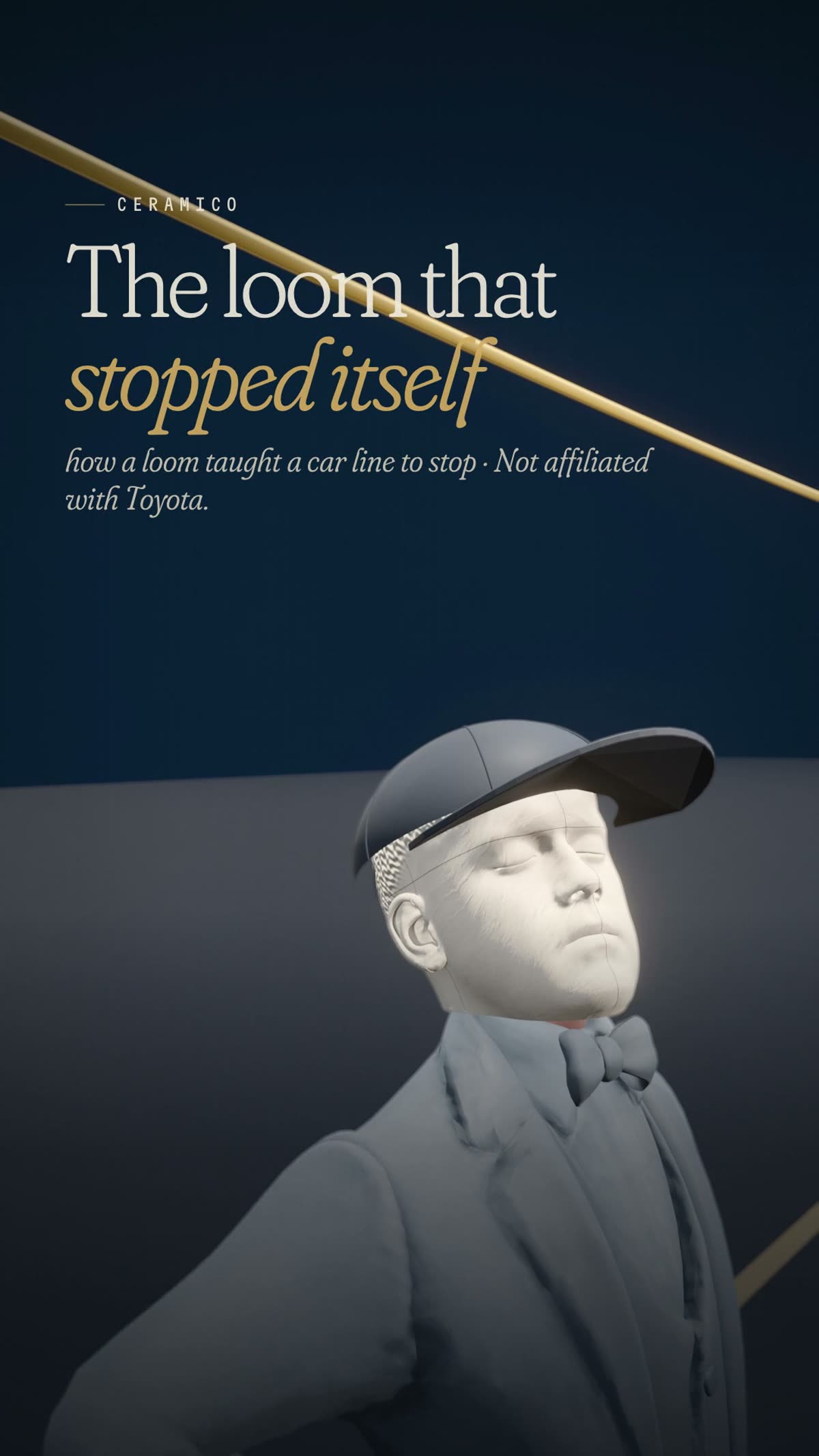 Watch the film · 1:09
On many Toyota assembly lines, a cord runs within reach of the workstations. Any line worker can pull it to call a stop. The idea behind it is older than the car company, and it started with thread.
A stopped production line builds nothing, so it seems odd for a carmaker to hand every worker a way to halt it. Toyota’s explanation is that the cord is not really about stopping. It is about noticing a problem the moment it happens and calling for help, a principle the company calls jidoka. Toyota traces it to a set of looms built by a carpenter’s son more than a century ago.
By the numbers
- Sakichi Toyoda’s hand-loom patent
- 1891
- Toyoda Power Loom with weft-stop device
- 1896 or 1897
- Type G non-stop shuttle-change loom designed
- 1924
- First Type G off the line
- November 1925
- Platt Brothers buys Type G rights
- 1929
- Toyota Motor Company registered
- 1937
Toyota’s own accounts give both 1896 and 1897 for the power loom. All dates are from Toyota and Toyota Industries histories.
The trouble with thread
Sakichi Toyoda was born in 1867, and according to Japan’s National Diet Library he was “born in Shizuoka as the son of a carpenter.” Toyota’s official history says the idea of improving looms struck him “while assisting with his father’s carpentry business,” and in Toyota’s telling he was also inspired by watching his mother weave. In 1891 he was granted a patent for a wooden hand loom. Toyota’s accounts date his first power loom, the Toyoda Power Loom, to 1896 in one place and 1897 in another; Toyota calls it Japan’s first self-powered loom.
Weaving is simple to describe and fiddly to do. Lengthwise threads, the warp, are held taut on the loom. A shuttle carrying the crosswise thread, the weft, shoots back and forth between them, and row by row the cloth builds up. The weak point is the thread itself. When a thread snaps or runs out, the loom can carry on weaving flawed cloth. The Japan Society of Mechanical Engineers notes that Toyoda’s later Type G loom kept an automatic stopping device that halted the machine when a warp or weft yarn broke, “to prevent defective products.” Without such a device, weavers had to watch their looms.
A machine that knows when to quit
Toyoda’s answer was to make the loom watch itself. According to Toyota, the Toyoda Power Loom “automatically stopped the machine when the weft thread in the shuttle broke or was exhausted.” A later power loom added a warp halting device that “automatically shut down the machine when the warp thread broke.” Toyota’s accounts place that addition in the early 1900s.
The mechanisms are wonderfully literal. On the Type G loom preserved at the Toyota Commemorative Museum of Industry and Technology, as described by the lean manufacturing writer Christoph Roser, a small piece of sheet metal hangs on each warp thread, held up by its tension. “If the warp breaks… the sheet metal drops down,” blocking a moving bar and stopping the machine. For the weft, a pronged fork presses against the thread; when there is no thread to push against, the fork passes through and the loom stops.
The payoff was labor. A loom that stops itself does not need someone standing over it. Toyota says the self-stopping design allowed “a single operator to run several looms at once.” Accounts of exactly how many vary, so several is as precise as the sources allow.
It is worth being clear about what Toyoda did not do. He was not the first to build a loom that stopped on a broken thread. Lancashire looms in Britain had weft stop motions patented by Kenworthy and Bullough in 1841, according to Grace’s Guide and Wikipedia, and a US patent for an automatic warp stop motion was granted in 1893. Toyota itself makes a narrower claim. What made Toyoda’s looms matter was what his company later did with the idea.
The film · 1:09
The Loom That Stopped Itself
A clay-style journey from Sakichi Toyoda’s self-stopping looms to the andon cord on a modern Toyota assembly line.
Watch more on Instagram Follow CERAMICO
Read the transcript
Toyota lets any line worker call a stop. Blame a loom. A stopped line builds nothing. So why? In the 1890s, a carpenter's son, Sakichi Toyoda, built looms. A shuttle shoots across long threads, weaving cloth. But threads snap. A snapped thread meant bad cloth, so weavers had to watch their looms. Here's the trick. Toyoda's looms stopped themselves when a thread broke or ran out. One person could now run several looms. In 1924, the Toyodas' Type G swapped in full shuttles without stopping. Sakichi's son Kiichiro founded Toyota's car company, and the loom's idea became a principle: jidoka. Toyota even respelled the Japanese word for automation, adding the sign for a person. Today a worker pulls a cord. A board lights, a leader comes. Not fixed in time? The line stops. So the loom never cut the person out. It just knew when to call one. Send this to anyone who never asks for help. That's why, a century on,
Animated model, illustrative and not to scale.
The Type G and a change without stopping
In 1924 came the Toyoda Type G automatic loom. Toyota calls it “the world’s first automatic loom with a non-stop shuttle-change motion.” Earlier automatic looms, such as the Northrop loom, could already refill the shuttle; the Type G’s trick was to swap in a full shuttle without slowing down. The Japan Society of Mechanical Engineers describes the change happening “without reducing the speed during high-speed operation.” Toyota Industries credits Sakichi with the invention, while Toyota’s own 75-year history files it under his son Kiichiro, so it is fairest to call it the Toyodas’ loom. The first unit came off the line in November 1925, according to Toyota.
The design attracted attention abroad. In 1929 the British textile machinery maker Platt Brothers bought rights to the Type G. The headline price was £100,000, but Toyota’s history records that the unpaid balance was reduced in 1934, bringing the total to £83,500. A popular story holds that this money paid for Toyota’s move into cars. A peer-reviewed study by the business historian Kazuo Wada argues the evidence does not support that tale, so we leave it there.
What is not in dispute is the family line. Sakichi’s son Kiichiro, in Toyota’s words “the founder of Toyota Motor Corporation,” is credited as its founder. The company grew out of the automobile department of Toyoda Automatic Loom Works and was registered as the Toyota Motor Company in 1937.
From loom to andon
The loom’s idea did not stay in the textile mill. Toyota describes its production system as “based on two pillars,” and jidoka is one of them, defined as “stopping immediately when abnormalities are detected.” The other is Just-in-Time. Toyota’s history notes that Taiichi Ohno, the architect of the Toyota Production System, named Sakichi’s weft and warp halting devices as the origin of jidoka in a 1969 article.
Toyota even respelled the Japanese word for automation to make the point. The ordinary word is 自動化, in which the middle character 動 means to move. Toyota writes jidoka as 自働化, using 働, which adds the radical for a person. The Lean Enterprise Institute describes it as “a Toyota-created word pronounced exactly the same as the Japanese word for automation.” Toyota glosses it in English as “automation with a human touch.”
On today’s lines, that human touch is the andon. The word means sign or signal and, according to Toyota UK, comes from a paper lantern. At Toyota’s Burnaston plant in England, the cord “runs the entire length of the production line.” When a team member pulls it, “the Andon board lights up with a number that corresponds to the member’s workstation,” and a team leader comes to help. Some plants use a call button instead of a cord.
The loom never cut the person out; it just knew when to call one.
Here is where the popular version goes wrong. Pulling the cord does not freeze the factory. As the Lean Enterprise Institute explains it, “If the problem can’t be corrected within the remainder of the cycle time, the line stops at the end of the work cycle.” Toyota UK says that if the problem can be fixed in time, “then production continues.” The lean writer Mark Graban, in a 2026 piece titled “No, One Toyota Worker Cannot Stop the Whole Factory,” puts it plainly: “The line stops at the next fixed position if the problem has not been resolved in time.” The pull is a call first. The stop comes only if the call is not enough.
Why it matters
The self-stopping loom saved labor, and Toyota is candid that this was part of the point: machines that stop themselves “no longer need to be watched over.” The loom never cut the person out; it just knew when to call one. That is the real inheritance. A machine, or a line, that halts at the first sign of trouble is meant to keep a small problem from becoming a pile of bad cloth or a row of faulty cars, and it brings a human to the spot where the trouble began.
A century on, the principle still runs through Toyota’s plants. Toyota’s live production system page still says, in the present tense, that an operator “can stop the line by pulling the stop cord themselves.” It is a habit that started with a thread, a falling tab of sheet metal, and a loom that knew when to quit.
Sources
Every line in the film was checked against these sources by an independent fact-checker before publication. Company claims are attributed to the company that made them.
- Toyota: Toyota Production System
- Toyota: Toyota Production System (plant tour, English)
- Toyota: Toyota Production System (plant tour, Japanese)
- Toyota, 75 Years of Toyota: Sakichi’s early life and the wooden hand loom
- Toyota, 75 Years of Toyota: The Toyoda Power Loom
- Toyota, 75 Years of Toyota: Kiichiro Toyoda and the automatic loom
- Toyota, 75 Years of Toyota: Patent transfer agreement with Platt
- Toyota newsroom: Toyota donates Type G automatic loom to Britain’s Science Museum
- Toyota global newsroom
- Toyota Industries: History
- JSME: Mechanical Engineering Heritage No. 16, Toyoda Automatic Loom Type G
- Science Museum Group: Toyoda automatic loom
- Science Museum Group: Northrop loom
- TCMIT: Non-stop shuttle-change automatic loom Type G (virtual tour)
- TCMIT: Agreement and Kiichiro’s lab notes (virtual tour)
- Toyota UK Magazine: Toyota manufacturing in 25 objects, the andon cord
- Toyota UK Magazine: Andon, Toyota Production System guide
- Toyota UK Magazine: Toyota history, from loom to vroom
- Lean Enterprise Institute: Fixed-position stop system
- Lean Enterprise Institute: Jidoka
- LeanBlog: No, one Toyota worker cannot stop the whole factory
- AllAboutLean: The Toyoda Model G loom
- AllAboutLean: What exactly is jidoka?
- Business History (via RePEc): Wada, The fable of the birth of the Japanese automobile industry
- Google Patents: US 491,139, Automatic warp stop-motion for looms
- Wikipedia: Lancashire Loom
- Grace’s Guide: James Bullough
- Grace’s Guide: Platt Brothers
- National Diet Library: Portraits of modern Japanese historical figures, Toyoda Sakichi
- Japan Patent Office: Sakichi Toyoda
- Wikimedia Commons: Toyota car logo
- Wikimedia Commons: Toyota symbol
Updates and corrections
- First published.
See an error? Tell us. We correct promptly and say what changed. Our corrections policy.
Disclosure
This is an independent explainer. CERAMICO is not affiliated with, sponsored by, or speaking for any company, brand, agency or person named in this story, and nothing here is official.
Claims are attributed. Where a figure or description comes from a company or an expert, we say so. CERAMICO is not affiliated with Toyota or Toyota Industries. Brand names identify the companies only. The animation is an illustrative model, not to scale.
Animations are illustrative. Our films use clay-style 3D models. They are not to scale and are simplified to show how something works.
Trademarks and product names belong to their owners and are used only to identify what we are describing.
Keep reading

The penalty for turning left: how UPS taught its routing software to put a price on risk
UPS trucks are famous for not turning left. The truth is subtler: UPS built software that makes a left cost more, then lets the math decide.
The Dreamliner’s missing window shade is a chemical reaction you switch on
There is no blind at a 787 window seat, only a button. Behind it sits a thin gel that turns dark when a small voltage moves its electrons, and clears again the moment the power stops.
Magic Kingdom’s trash rides a 60 mph wind, but first somebody has to carry it
Since 1971, a Swedish-designed vacuum system has whisked Walt Disney World’s trash through 20-inch pipes in the utilidors. The surprise is how much of the job is still done by hand.