Technology · How it works
Magic Kingdom’s trash rides a 60 mph wind, but first somebody has to carry it
Since 1971, a Swedish-designed vacuum system has whisked Walt Disney World’s trash through 20-inch pipes in the utilidors. The surprise is how much of the job is still done by hand.
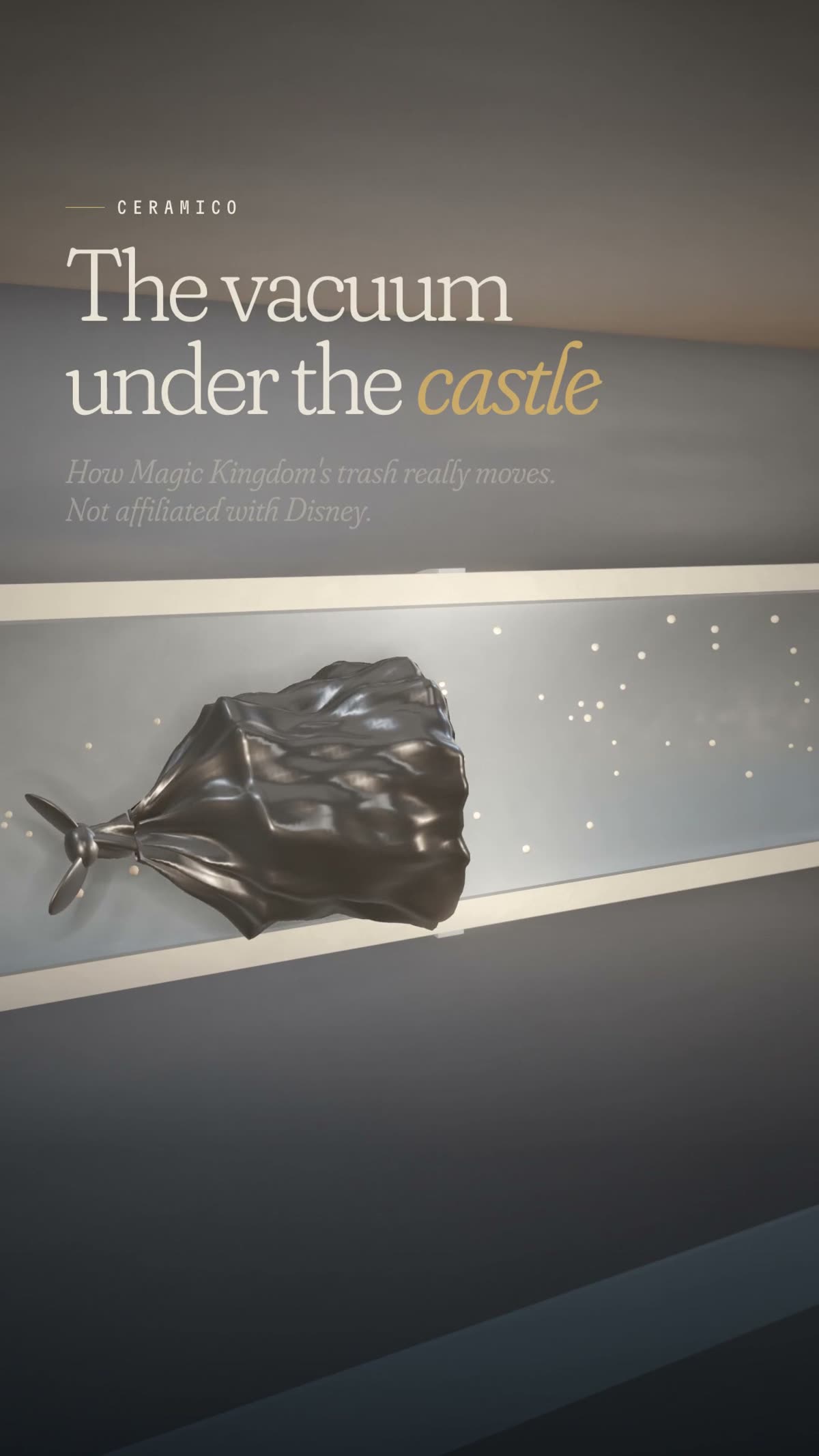 Watch the film · 1:06
You drop a popcorn box into a bin on Main Street, U.S.A., and it seems to vanish. Below the street, a wind of nearly 60 miles an hour is waiting for it.
Walt Disney World has spent more than half a century making its trash disappear without anyone seeing a garbage truck. Phil Holmes, a former vice president of Magic Kingdom, put the goal plainly to WKMG News 6 in 2021: “No need for trucks to come anywhere close to the guest.” The tool that makes that possible is a vacuum system called AVAC, short for Automated Vacuum Collection, and it has been running under the park since 1971.
How it works is mostly what you would guess. Who actually feeds it is not.
By the numbers
- Air speed in the pipes
- nearly 60 mph
- Transport pipe diameter
- 20 inches
- Pipe network, 1973
- 6,000 feet
- Inlets serving the park, 1973 to 2017
- 15 to 17
- Collection cycle
- every 15 to 20 minutes
- Exhausters at the plant
- 3 200 hp each
- In service since
- 1971
Figures come from trade, government and press reports published between 1973 and 2021, not from Disney. The 60 mph figure describes the moving air, not the trash.
A Swedish vacuum in central Florida
Vacuum trash collection was invented in Sweden in the early 1960s. According to a 2015 engineering review in MSW Management, its originator headed a company called Centralsug AB, which later became Envac. When Disney announced its system in 1969, the press release named Aerojet-General Corporation as the designer. The two accounts fit together: a history of the technology compiled by the Fast Trash exhibition notes that Centralsug’s first U.S. distributor was Envirogenics, a subsidiary of Aerojet-General, and Envac’s own website lists the Disney World complex among the places it has delivered systems.
When Magic Kingdom opened on October 1, 1971, it became, in the words of Atlas Obscura, “the first place in the United States to boast such a system.” Envac dates its installation on New York’s Roosevelt Island to 1975.
Inside the pipe
The basic machine is a long tube with a strong fan at one end. In a typical AVAC layout, described in an Envac patent, waste drops into an inlet and rests above a closed discharge valve. Several times an hour, the system runs a cycle. Reports differ on the interval: a 2014 New Jersey Department of Environmental Protection bulletin says every twenty minutes, while later accounts say every fifteen.
During a cycle, fans at a central plant pull air out of the network. A 1973 report in the trade journal Solid Wastes Management described “three 200-horsepower exhausters which create a 60-miles-an-hour vacuum that conveys the refuse through the pipes.” Only two of the three ran at once; the third was held in reserve. When an inlet’s valve opens, its load of trash is pulled into that rushing air and carried away.
The same 1973 report gives the plumbing: 6,000 feet of 20-inch transport pipe, mostly wrapped in two inches of acoustical insulation. Twenty inches is wider than a basketball hoop, whose ring the NBA rulebook sets at 18 inches across. A 1984 trade report said the system took in 50 tons of refuse a day. At the end of the line, the trash reaches a central collection building where it is compacted and trucked away.
Two common descriptions get the physics slightly wrong. The first is that the trash itself flies at 60 miles an hour. The 1973 source attaches that figure to the vacuum, the moving air, and the material being carried moves at or below the speed of the air. Envac, describing its modern systems in general, says they move waste at up to 70 kilometers per hour, about 43 miles an hour. The second is that the system blows the trash along with compressed air. It does the opposite: the exhausters create suction, and the trash is pulled.
The film · 1:06
The Vacuum Under the Castle
A clay-animated ride through Magic Kingdom’s vacuum trash system, from a bag on a shut valve to the central plant, and the custodians who make it work.
Watch more on Instagram Follow CERAMICO
Read the transcript
Magic Kingdom's trash rides a wind of nearly 60 miles an hour. Yet no garbage truck comes near you. The secret is a Swedish vacuum, running since 1971. A bag drops into an inlet, and waits on a shut valve. Several times an hour, giant fans suck the air from the pipes. But the tunnel they run through isn't underground. Florida's water table is high, so the tunnels were built on the ground, and the park on top. Disney says you're walking on the second floor. So when the valve opens, the bag shoots into a pipe wider than a basketball hoop, and that wind carries it to a central plant that crushes it. Now the twist. The can you used usually isn't hooked up at all. A custodian empties it, and walks the bag to one of fewer than 20 inlets. The vacuum is fast. The magic is people carrying bags, day and night. Send this to whoever thinks the bins are bottomless. Because once it's in...
Animated model, illustrative and not to scale.
The basement that isn’t
The pipes run through the utilidors, the network of service corridors that lets cast members, supplies and trash move around Magic Kingdom out of sight. Disney’s own tour page says the corridors allow “Cast Members, deliveries and even rubbish to be unknowingly transported” beneath guests.
They are usually described as underground tunnels. They are not, quite. According to the Walt Disney Archives’ Disney A to Z, “because of the high water table in Florida, the Utilidors had to be built on top of the ground.” The New Jersey bulletin adds that soil dug out of the resort’s Seven Seas Lagoon was deposited on top of the ground-level passageways. WKMG reported that this put much of the park an average of 14 feet above normal ground level.
Disney says so itself. Its Keys to the Kingdom tour page states that the guest areas of Magic Kingdom “are actually on the second floor of a massive structure.” The trash, in other words, is not sinking into the earth. For much of its trip, it travels along the ground floor while you walk around upstairs.
The trash is not sinking into the earth. For much of its trip, it travels along the ground floor while you walk around upstairs.
The twist: people with bags
Here is the part the vacuum gets credit for but does not do. The bin you used is usually not connected to any pipe at all.
The numbers make the point. Reports have counted 16 inlets in 1973 (a count that included the Contemporary Resort hotel), 15 in 1984 and 17 in 2017, fewer than twenty in every case. The 1984 report said those stations “resemble 55-gallon drums.” A park full of guests uses far more bins than that.
So the link between bin and pipe is a person. The 1973 article described it directly: “Refuse containers located on the park grounds are equipped with plastic inserts which are removed by attendants and carried by hand to the nearest depository.” Holmes, in 2021, described the step as going “to a major receptacle, you pour it down.” Disney Food Blog reported in 2024 that custodians collect trash “twenty-four hours a day” and dump it into processors throughout the park.
The myth that every bin is secretly a vacuum tube persists online anyway. A 2026 fan post put it bluntly: “Disney trash cans do not suck trash into a secret tube.” One government bulletin did describe the system sucking trash from oversized garbage cans bolted to the ground, but those bolted-down drums are the inlets themselves, not the bins along the sidewalk. A few inlets may sit where guests can see them, which is why “usually” matters.
Still running, mostly unseen
The system was meant to be a template. Atlas Obscura’s history is titled, in part, “Disney’s Unlikely Garbage Innovation Was Supposed to Sweep the Country.” It did not, but the Magic Kingdom installation kept working. “It works as well today as it did, you know almost 50 years ago,” Holmes told WKMG in 2021. Fan sites described it in the present tense in 2024 and again in 2026, and no report of its removal has surfaced, although Disney itself has not named the AVAC in a recent public statement.
The bins on top are changing. In 2026, fan outlets reported that Disney was rolling out solar-powered bins that compact their own contents, and WDWNT spotted them at Magic Kingdom. Whatever the bin, the system underneath depends on the same thing it always has: a 20-inch pipe, a very strong fan, and someone walking a bag to the nearest inlet, day and night.
Sources
Every line in the film was checked against these sources by an independent fact-checker before publication. Company claims are attributed to the company that made them.
- hiddenmickeys.org: Fun facts of Magic Kingdom’s underground complex (archived)
- WKMG ClickOrlando: Water wonders of the world, Seven Seas Lagoon and Bay Lake (2021, archived)
- Waste360: A look at Walt Disney World’s underground trash tubes (2017, archived)
- Disney Food Blog: The nasty smell coming from under Magic Kingdom (2024, archived)
- Atlas Obscura: Disney’s unlikely garbage innovation was supposed to sweep the country (2016, archived)
- Florida Legislature: Florida Statutes § 316.183, speed limits
- AllEars: Things you won’t believe about Disney trash
- Internet Archive: Solid Wastes Management, May 1973
- BlogMickey: Solar-powered trash cans rolling out to Walt Disney World parks (2026)
- Canadian Consulting Engineer: Underground garbage collection being installed in Montreal (2012)
- ASCE: Environmental systems at Walt Disney World (1975)
- Wikimedia Commons: Walt Disney World logo (2018)
- D23: Disney A to Z, Cinderella Castle
- D23: Disney A to Z, Magic Kingdom Park
- D23: Disney A to Z, Utilidors
- Disney Parks Blog: New Disney World candy containers inspired by trash cans (2025)
- Walt Disney World: Disney’s Keys to the Kingdom tour
- Wikipedia: Cinderella Castle
- Wikipedia: Disney utilidor system
- Fast Trash: Vacuum collection exhibition
- NBA: Official Rule No. 1, court dimensions and equipment
- One Man’s Dreamers: Disney trash can (2026)
- Google Patents: US 9,302,849 B2, controlling a pneumatic conveying system (Envac)
- Philadelphia Magazine: the Disneyland trash can theory
- Trash Cans Unlimited: Garbage collection at Walt Disney World
- Wikimedia Commons: Walt Disney World logo file (2018)
- WDWNT: Are Walt Disney World’s new garbage cans too complicated? (2026)
- World of Walt: Disney’s underground trash tubes (2017)
- WKMG ClickOrlando: The utilidors, inside the Magic Kingdom’s secret underground city (2021)
- DisneyDocs: Walt Disney World documents
- DIX: Solid Wastes Management, At Disney World (1973)
- DIX: The Management of World Wastes, Wastes removed like magic at Disney World (1984)
- Envac: Step-by-step guide to pneumatic waste collection (2024)
- Envac: Roosevelt Island, NY
- NJ Department of Environmental Protection: WasteWise Bulletin, Winter 2014 (PDF)
- MSW Management (SCS Engineers): Improving the livability of our cities (2015, PDF)
- Waste360: A look at Walt Disney World’s underground trash tubes (2017)
Updates and corrections
- First published.
See an error? Tell us. We correct promptly and say what changed. Our corrections policy.
Disclosure
This is an independent explainer. CERAMICO is not affiliated with, sponsored by, or speaking for any company, brand, agency or person named in this story, and nothing here is official.
Claims are attributed. Where a figure or description comes from a company or an expert, we say so. CERAMICO is not affiliated with Disney. Brand names identify the place only. System details come from trade and press reports from 1973 to 2026. The animation is an illustrative model, not to scale.
Animations are illustrative. Our films use clay-style 3D models. They are not to scale and are simplified to show how something works.
Trademarks and product names belong to their owners and are used only to identify what we are describing.
Keep reading
The penalty for turning left: how UPS taught its routing software to put a price on risk
UPS trucks are famous for not turning left. The truth is subtler: UPS built software that makes a left cost more, then lets the math decide.

The loom that stopped itself: how a weaving machine gave Toyota its andon cord
Toyota lets any line worker call a stop. The reason goes back to a carpenter’s son, a snapped thread, and a loom built to notice when something went wrong.

The Dreamliner’s missing window shade is a chemical reaction you switch on
There is no blind at a 787 window seat, only a button. Behind it sits a thin gel that turns dark when a small voltage moves its electrons, and clears again the moment the power stops.