Technology · How it worked
Early Spotify often streamed your songs from strangers’ computers. Here is how it worked
In 2010, Spotify’s desktop app got less than a tenth of its music from Spotify’s servers. The rest came from your own cache and from other listeners.
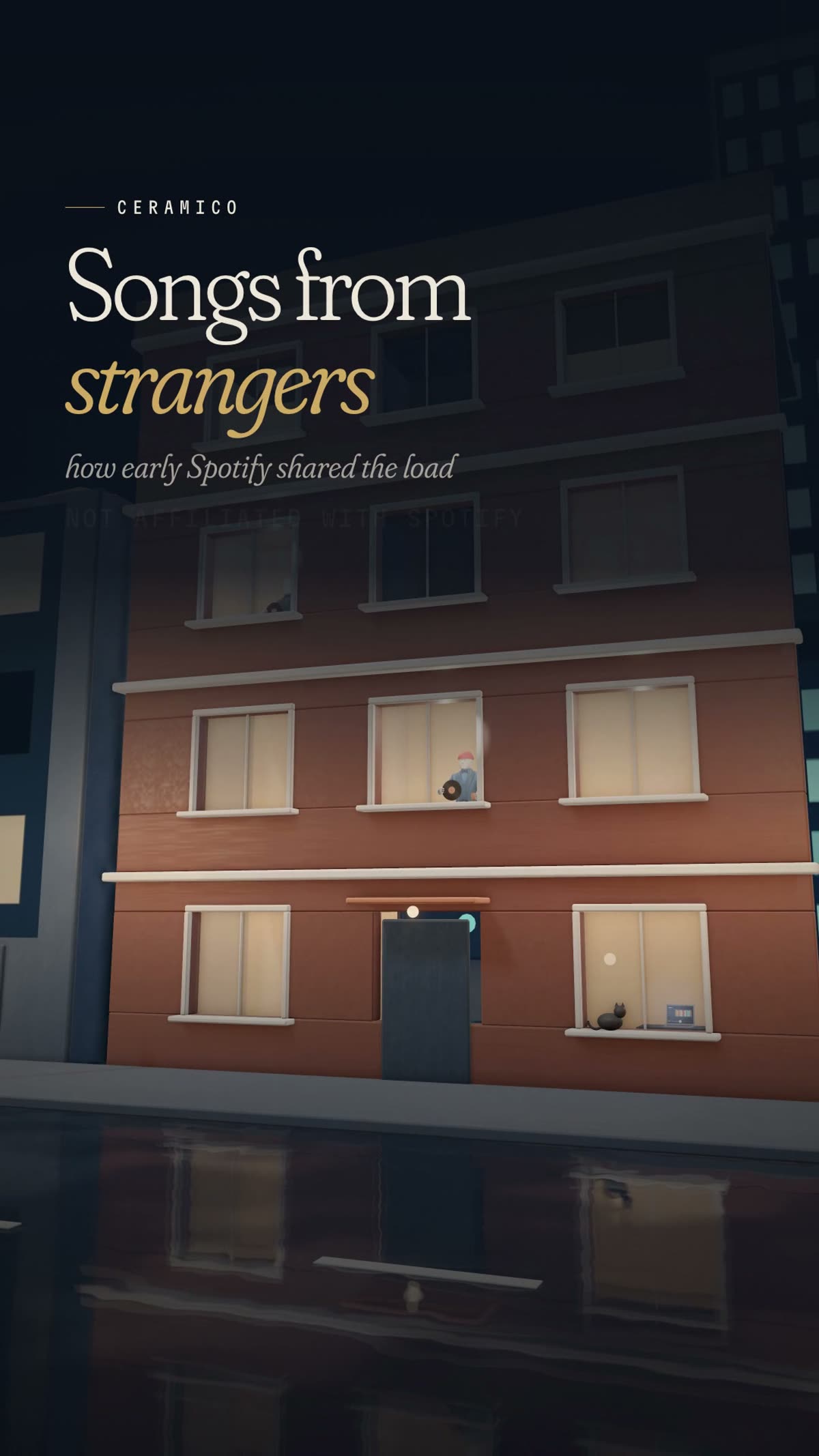 Watch the film · 1:06
In one week of March 2010, less than a tenth of the music data played by Spotify’s desktop apps came from Spotify’s own servers.
That is a measurement, published by Spotify’s own engineers. Between Tuesday 23 March and Monday 29 March 2010, the desktop apps got only 8.8% of their music data from Spotify’s servers. Over half came from the listener’s own computer. Over a third came from other listeners.
Early Spotify, in other words, was partly a peer-to-peer network. The desktop app on your computer could hand music to strangers, and theirs could hand music to you. It wasn’t a secret or a hack: the design was described in a paper presented at the IEEE P2P 2010 conference by two authors from KTH and Spotify. Here is how it worked, and how it ended.
By the numbers
- Music data from Spotify’s servers
- 8.8 %
- Music data from other listeners
- 35.8 %
- Music data from the listener’s own cache
- 55.4 %
- Opening audio first requested from the server
- about 15 seconds
- Peers a client uploaded to at once
- 4 at most
- Median playback latency
- 265 ms
Measured by Spotify engineers for the desktop apps in six European countries, 23 to 29 March 2010, and published at IEEE P2P 2010. Phones did not take part in peer-to-peer and are not included.
Built into the desktop app
The paper is plain about the design: “Streaming is performed by a combination of client-server access and a peer-to-peer protocol.” Spotify launched in October 2008, and at the time of the paper it served more than 7 million users in six European countries, with a catalog of more than 8 million tracks.
Only some of those users were peers. Spotify had desktop clients for OS X and Windows, plus apps for several smartphone platforms, and the paper notes that “The smartphone clients do not participate at all in the peer-to-peer protocol.” Phones streamed only from Spotify’s servers. TechCrunch later reported that the mobile app and the web interface never used peer-to-peer at all. This was a desktop story.
On the desktop, every listener was an equal. The paper describes a network with no “supernodes”: no specially powerful machines in charge, just ordinary computers running the app, helped along by Spotify’s own servers and trackers.
Three places a song could come from
Back then, a song could reach your speakers from three places.
Your own computer. The app kept what the paper calls “relatively large” local caches of tracks it had downloaded. People often listen to the same song several times, and caching meant a track didn’t need to be downloaded again. Old tracks were cleared out on a least-recently-used basis. The cache was locked, too: “Cached content is encrypted and cannot be used by other players,” the paper says. You couldn’t lift the files into another music player.
Other listeners. Those same caches were what each app offered to its peers. The paper notes that a client offered only tracks it had cached completely, and uploaded to at most four peers at a time. Your laptop, quietly, was a tiny lending library for strangers, and theirs were lending libraries for you.
Spotify’s servers. The servers filled the gaps, and above all they handled the start of a song, where speed mattered most.
The film · 1:06
Songs From Strangers
In a clay city at night, records hop from window to window as early Spotify’s desktop apps share music with one another.
Watch more on Instagram Follow CERAMICO
Read the transcript
Early Spotify often streamed your songs from strangers' computers. It wasn't a hack. Spotify built it into its desktop app. Back then, a song could come from three different places. First, your own computer. Songs you played were saved in a local cache. That cache was encrypted, so other music players couldn't use it. Second, other listeners. Your app offered your cached songs to them, and theirs to you. Press play, and the app asked Spotify's tracker, and other listeners, who had that song. Third, Spotify's servers sent about the first 15 seconds. Other listeners usually sent the rest. In one week of 2010, desktop apps got only 8.8% of their music from Spotify's servers. Over a third came from other listeners. Over half was already on people's own computers. In 2014, Spotify said it was phasing that out, in favour of more servers. So back then, your next song may have come from a stranger's computer.
Animated model, illustrative and not to scale.
Pressing play, in 2010
When you picked a new song, the app went looking in two ways at once. The paper describes two mechanisms to find peers: a tracker in Spotify’s back end that knew which clients had which tracks, and a search sent through the peer-to-peer network itself, passed from client to connected client. Those connected clients were neighbors only in the network sense. The paper describes no matching by geography; peers were grouped by Spotify data center, with one in London and one in Stockholm.
Meanwhile, unless the track was already in your cache, the app asked Spotify’s server for roughly the first 15 seconds of music, so playback could start right away while peers were found. The paper reports a median playback latency of 265 milliseconds.
After that opening, the rest usually came from other listeners, with conditions. In the paper’s words, “As long as the client’s buffers are sufficiently full and there are peers to stream from, the client only streams from the peer-to-peer network.” If buffers ran low or no peers were available, the app went back to the server. A single track could arrive from the server and several peers at the same time. And when one track followed another in sequence, the app looked to peers for the next track first, asking the server for its start only if needed.
The music always played on your own computer. What came from strangers was data.
The numbers, and the ending
Here is the measured week in full. According to the paper, “8.8% of data came from servers, 35.8% from the peer-to-peer network, and the remaining 55.4% were cached data.” Leave the cache aside and look only at music that had to be fetched, and roughly four-fifths came from other listeners.
Your laptop, quietly, was a tiny lending library for strangers, and theirs were lending libraries for you.
Two cautions keep those figures honest. They cover the desktop apps only, since the paper set phones aside, and phones streamed entirely from servers. And they count data downloaded, not strictly songs heard. Still, the result was striking: a service with millions of users, getting under a tenth of its desktop music data from its own servers.
It didn’t last. In April 2014, a Spotify spokesperson told TorrentFreak, “We’re gradually phasing out the use of our desktop P2P technology,” adding, “We’re now at a stage where we can power music delivery through our growing number of servers.” That statement comes to us through TorrentFreak; other outlets, including TechCrunch, relied on its report, and no Spotify-hosted announcement has surfaced. Nor is there a published date for when peer-to-peer was finally switched off.
So the swarm faded into history, in favor of more servers. But for a few years, on desktop computers, your next song may have come from a stranger’s computer.
Sources
Every line in the film was checked against these sources by an independent fact-checker before publication. Company claims are attributed to the company that made them.
Updates and corrections
- First published.
See an error? Tell us. We correct promptly and say what changed. Our corrections policy.
Disclosure
This is an independent explainer. CERAMICO is not affiliated with, sponsored by, or speaking for any company, brand, agency or person named in this story, and nothing here is official.
Claims are attributed. Where a figure or description comes from a company or an expert, we say so. CERAMICO is not affiliated with, or endorsed by, Spotify. Brand names identify the product only. This describes Spotify’s desktop app as measured in 2010; Spotify said in 2014 that it was phasing peer-to-peer out. The animation is an illustrative model, not to scale.
Animations are illustrative. Our films use clay-style 3D models. They are not to scale and are simplified to show how something works.
Trademarks and product names belong to their owners and are used only to identify what we are describing.
Keep reading
The penalty for turning left: how UPS taught its routing software to put a price on risk
UPS trucks are famous for not turning left. The truth is subtler: UPS built software that makes a left cost more, then lets the math decide.

The loom that stopped itself: how a weaving machine gave Toyota its andon cord
Toyota lets any line worker call a stop. The reason goes back to a carpenter’s son, a snapped thread, and a loom built to notice when something went wrong.

The Dreamliner’s missing window shade is a chemical reaction you switch on
There is no blind at a 787 window seat, only a button. Behind it sits a thin gel that turns dark when a small voltage moves its electrons, and clears again the moment the power stops.