Technology · How it works
Your Coca-Cola Freestyle drink doesn’t exist until it falls into your cup
A Freestyle stores no finished drinks. It keeps parts, meters them with pumps precise enough to borrow ideas from medicine, and lets the flavors meet only on their way out of the nozzle.
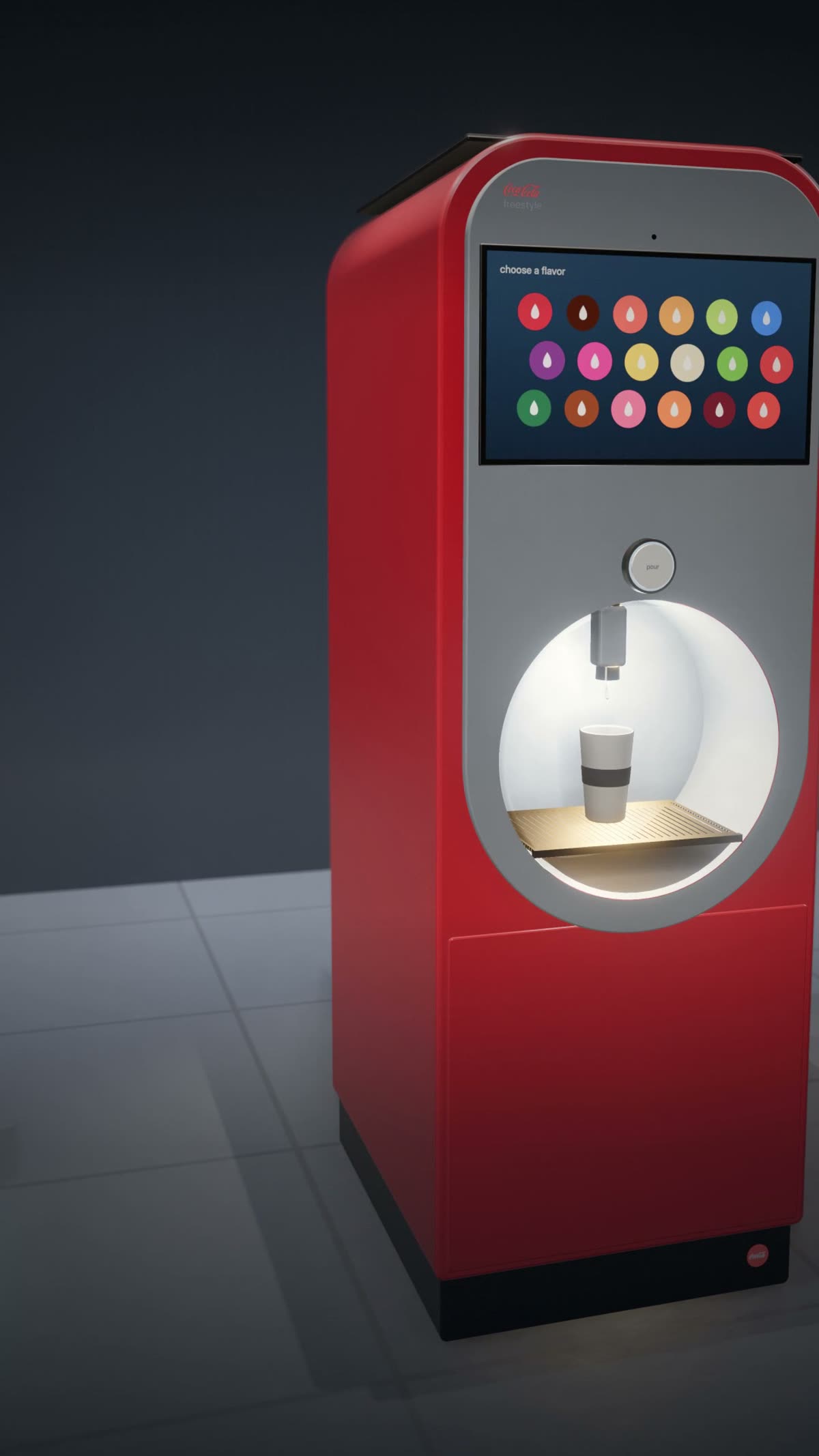 Watch the film · 1:09
Press pour on a Coca-Cola Freestyle and watch the stream closely. The drink filling your cup did not exist a second ago.
Freestyle is Coca-Cola’s touchscreen fountain dispenser, on the market since 2009. Its selling point has always been choice. In a 2010 release inviting Austin to try it, Coca-Cola said it could dispense up to 106 branded drinks “in the same footprint as a standard eight-valve machine.” An eight-valve fountain pours eight drinks. Later counts climbed past 150, and in 2026 the Atlanta Journal-Constitution described up to 200 choices. The exact menu depends on the model and the restaurant, but every account agrees on more than a hundred.
The trick is not a bigger box. It is a different idea of what a drink is.
By the numbers
- On the market since
- 2009
- Drinks in an eight-valve footprint (2010)
- up to 106
- Ordinary fountain syrup ratio
- about 5:1 water to syrup
- Most diluted flavors, per Coca-Cola patents
- up to 300:1
- That ratio as a measure
- 1 teaspoon per 1.5 liters
- Drinks poured since launch (2026)
- about 66 billion
- Daily pours, U.S. and Canada (2026)
- about 11 million
The 300:1 figure is a permissive range in Coca-Cola patents, not a measured cartridge value. The 2026 pour figures were reported by the Atlanta Journal-Constitution. Drink counts vary by model and location.
Parts, not syrups
A conventional fountain keeps one syrup for each drink, often in a bag-in-box container, and mixes it with water at the valve. The usual recipe is about five parts water to one part syrup, a figure given both in Coca-Cola’s history of the project and in an independent dispenser patent from IMI Cornelius. In Coca-Cola’s oral history, one of the people behind Freestyle recalls the question that started it: “syrup is five-to-one, well, why? Is that the magic ratio?”
Freestyle answers by breaking each drink into parts. Coca-Cola’s 2006 patent filings describe three kinds of ingredient: water, plain or carbonated; “macro-ingredients” such as sweetener, mixed at about 3:1 to 6:1; and “micro-ingredients,” the flavors, which are far more concentrated. The bulky sweetener can sit in a bag-in-box outside the dispenser. The flavors live inside the cabinet in what the Wall Street Journal, as quoted by Marketplace, called “dozens of plastic cartridges.” Coca-Cola’s compact 2026 model, the Freestyle Mini, holds up to 16 cartridges and two bag-in-boxes under the counter.
Choose a drink on the screen, and a stored recipe takes over. In the words of one Coca-Cola patent, the interface “instructs the pumps or metering devices” to dispense a set type and ratio of each ingredient. A cherry vanilla something is not stored anywhere. It is a line of instructions.
A teaspoon in a liter and a half
The flavors are where the engineering gets hard. Two Coca-Cola patents say many micro-ingredients may be diluted anywhere from 50 to 1 up to 300 to 1. That is a range written into patents, not a published figure for any particular cartridge, but it gives a sense of scale. Federal labeling rules define a teaspoon as 5 milliliters. At 300 to 1, one teaspoon of concentrate flavors a liter and a half of water.
At that strength, a tiny error is a ruined drink. “These are high concentrate ingredients. So think about the error on a drop of lime or a drop of vanilla,” one of the project’s leads says in the company’s oral history. One patent describes a positive displacement pump that “provides portion control for the more highly concentrated micro-ingredients.”
A cherry vanilla something is not stored anywhere. It is a line of instructions.
To get there, Coca-Cola looked to medicine. In its oral history, the team describes “a share commonality with some work that was happening in the medical space,” thinking of IVs and fluids moving at different flow rates. It also brought in Dean Kamen, the inventor whose first major innovation, according to the National Inventors Hall of Fame, was the AutoSyringe, a wearable pump that “delivered precise doses of medication.” Kamen, also known for the Segway, “came to the table with a whole bunch of ideas,” the company recalls.
Press coverage in 2010 went further, with IEEE Spectrum describing a microdosing technology developed for chemotherapy drugs. Coca-Cola’s own account is more modest. The pump it settled on came, it says, “from a Coca‑Cola coffee project.” Medicine offered a model; the pump itself had a more caffeinated pedigree.
The film · 1:09
Mixed in Mid-Air
A clay-animated look inside a Coca-Cola Freestyle, where concentrated flavors take separate paths through the nozzle and mix only as the drink falls.
Watch more on Instagram Follow CERAMICO
Read the transcript
Inside a Coca-Cola Freestyle machine, your drink doesn't exist yet. It's mixed in mid-air, right above your cup. An eight-nozzle fountain pours eight drinks. Freestyle, same space: over a hundred. Because it uses parts, not one syrup per drink: sweetener, water, dozens of flavor cartridges. But per Coke's patents, some are thinned up to 300 to one: a teaspoon per 1.5 liters. So pumps must be exact. Coke looked to medicine, where pumps give tiny doses, and brought in Dean Kamen, inventor of a wearable drug pump. Tap the screen: a recipe tells each pump how much to give. Here's the clever part: inside the nozzle, the flavors never touch. Each takes its own path. They meet on the way out, mixing as they fall. Coke's patent even runs the water on, rinsing the flavor away. Your drink was never stored anywhere. It was assembled, falling. Send this to the friend who mixes every flavor at once. Because until you press pour…
Animated model, illustrative and not to scale.
The nozzle where the flavors never touch
All those precise doses still have to reach the cup without contaminating one another. That job falls to the nozzle, which a project lead calls “probably one of the strongest patents we have.” Describing it in the oral history, a project lead put it simply: “It’s an air mix nozzle so they don’t touch. They mix in the air.”
The 2006 nozzle patent shows how. At the center is a flow director with its own paths for water and for the sweetener. Around it is a ring of small conduits, one for each flavor, each sized to suit its pump. Inside the nozzle, the flavors never share a channel. In the patent’s main design, the separate streams leave their openings and run down the grooves of a slim, finned post called a target, where they begin to mix. They keep mixing as they fall and finish in the cup. In another version with no post at all, the streams simply meet in the air.
The same patent adds a tidy finishing step: the flavor stream can stop before the water does, “so as to flush the colored fluid off of the target.” That is a method in a patent, not a promise about every machine in the field, and it does not mean zero carry-over. Coca-Cola has also patented a different nozzle with a mixing core inside, and in 2026 it announced a self-cleaning nozzle as a new add-on.
Still pouring
Freestyle is not a museum piece. In May 2026, Coca-Cola announced a redesigned interface called Equinox, “arriving June 23, 2026,” along with the smaller Freestyle Mini, and said it draws data from “tens of thousands of machines.” The Atlanta Journal-Constitution reported the same month that Freestyle machines had poured about 66 billion drinks since 2009, and were pouring roughly 11 million a day in the United States and Canada.
Building drinks from parts also made the machine programmable in ways a row of syrup valves is not. In 2014, Coca-Cola announced an app enhancement that connected Freestyle with users so they could dispense their own personal beverage mix.
So the next time you stand at the screen, it helps to picture what is really waiting behind it: a set of very strong ingredients, each in its own lane, and a recipe ready to send them out together. Until you press pour, your drink is only an idea.
Sources
Every line in the film was checked against these sources by an independent fact-checker before publication. Company claims are attributed to the company that made them.
- ACHR News: The 100-choice soft drink dispenser (2009)
- Wikimedia Commons: Coca-Cola logo
- Wikipedia: Coca-Cola Freestyle
- Plexus: Award of next-generation Coca-Cola Freestyle fountain dispenser (2019)
- The Coca-Cola Company: Coca-Cola invites Austin to experience Freestyle (2010)
- The Coca-Cola Company: New app enhancement connects Coca-Cola Freestyle with users (2014)
- Google Patents: US 11,713,233 B2, rationalizing ingredients (Coca-Cola)
- Google Patents: US 2007/0205220 A1, juice dispensing system (Coca-Cola)
- Google Patents: US 2019/0194009 A1, beverage nozzle with mixing core (Coca-Cola)
- Google Patents: US 7,578,415 B2, dispensing nozzle assembly (Coca-Cola)
- Google Patents: US 7,757,896 B2, beverage dispensing system (Coca-Cola)
- Google Patents: US 8,567,642 B2, highly concentrated beverage syrup (IMI Cornelius)
- IEEE Spectrum: Overengineering the soda machine (2010)
- Atlanta Journal-Constitution: In a hidden lab in Atlanta, Coca-Cola tests new beverage technology (2026)
- The Coca-Cola Company: How the Coca-Cola Freestyle dispenser came to be (2017)
- The Coca-Cola Company: Media center
- The Coca-Cola Company: Next generation of beverage dispensing (2026)
- The Coca-Cola Company: Next generation of beverage dispensing (2026, alternate URL)
- Computerwoche: Mit IoT zum vernetzten Getränkeautomaten (2016)
- NACS Daily: Coca-Cola rolls out upgrades to its Freestyle (2018)
- Core77: The iPod of drink machines (2009)
- DEKA Research & Development: Founder
- Houma Times: Wendy’s Freestyle test (2011)
- National Inventors Hall of Fame: Dean Kamen
- Cornell LII: 21 CFR 101.9, nutrition labeling of food
- Marketplace: Coke has high hopes for Freestyle machines (2010)
Updates and corrections
- First published.
See an error? Tell us. We correct promptly and say what changed. Our corrections policy.
Disclosure
This is an independent explainer. CERAMICO is not affiliated with, sponsored by, or speaking for any company, brand, agency or person named in this story, and nothing here is official.
Claims are attributed. Where a figure or description comes from a company or an expert, we say so. CERAMICO is not affiliated with The Coca-Cola Company or with Dean Kamen or DEKA. Brand names identify the product only. The animation is an illustrative model, not to scale.
Animations are illustrative. Our films use clay-style 3D models. They are not to scale and are simplified to show how something works.
Trademarks and product names belong to their owners and are used only to identify what we are describing.
Keep reading
The penalty for turning left: how UPS taught its routing software to put a price on risk
UPS trucks are famous for not turning left. The truth is subtler: UPS built software that makes a left cost more, then lets the math decide.
The loom that stopped itself: how a weaving machine gave Toyota its andon cord
Toyota lets any line worker call a stop. The reason goes back to a carpenter’s son, a snapped thread, and a loom built to notice when something went wrong.
The Dreamliner’s missing window shade is a chemical reaction you switch on
There is no blind at a 787 window seat, only a button. Behind it sits a thin gel that turns dark when a small voltage moves its electrons, and clears again the moment the power stops.