Aviation · Explainer
Five miles in a minute: inside the Palm Beach County Learjet crash, and the four theories nobody has proven
Two minutes before the mayday, the crew called the ice “manageable.” What followed took about a minute. Our three-part animated series follows the reported data from cruise to impact, and weighs four theories that no investigator has confirmed.
Facts as of Monday morning, 2 November 2026, before the NTSB’s first scheduled briefing.

Two minutes before the mayday, the crew called the ice “manageable.”
It was Sunday, 1 November. A 22-year-old Learjet 60, a twin-engine business jet, had left Austin, Texas, for the Bahamas with nine people aboard. It never arrived. About a minute after the first distress call, the jet had fallen roughly five miles and struck the ground in Greenacres, in Palm Beach County, Florida. News reports placed the impact near a busy road, feet from homes. The U.S. transportation secretary said all nine people aboard had died. No one on the ground was reported hurt.
What happened in that minute is now a question for the National Transportation Safety Board, which is investigating. The NTSB has not determined a cause, and neither have we. What follows is a reconstruction from public reporting: air traffic audio as reported by CNN, NBC and other outlets, statements from the Federal Aviation Administration, flight tracking data, and one unofficial track review. Where a figure comes from that unofficial review, we say so. Where people have offered theories, we name who offered them, and we explain what would prove them wrong.
By the numbers
- Aboard
- 9
- Cruise altitude
- 41,000 ft
- Outside air
- −47 °C
- Fall
- ~5 miles in ~1 min
- Transponder limit
- 32,640 ft/min
- Peak descent*
- 50,000+ ft/min
- Last altitude report
- 8,750 ft
- Typical NTSB process
- 12–24 months
* Calculated from GPS data by an unofficial track review. Not an official figure.
I. Into the storms
The flight climbed to 41,000 feet, a cruising altitude that Flightradar24’s data confirms. Near Naples, on Florida’s Gulf Coast, it began a descent toward 35,000 feet, into a sky crowded with thunderstorms.
Flight tracking suggests the jet passed through a strong storm cell. Minutes before the dive, the crew radioed air traffic control in Miami. As reported by the networks, they described light, clear ice and moderate turbulence. The outside air temperature was about minus 47 degrees Celsius. Turbulence was moving the aircraft up and down by as much as 700 feet. The crew asked to climb.
According to the unofficial track review, the jet rose for about ten seconds. Then the nose dropped.
The mayday came next. The radio calls, as reported, trace the descent: ten thousand feet a minute, then twenty thousand, then overspeed. In about a minute, the jet came down roughly five miles.
Part 1 of 3 · 1:02
Manageable
The flight, the storms and the radio calls: light clear ice, moderate turbulence, minus 47 degrees, and a request to climb. Then the nose drops.
Watch Part 1 on Instagram Follow CERAMICO
Read the transcript
What made a private jet fall five miles in about a minute? Two minutes before the mayday call, this crew called the ice manageable. Sunday morning, a twenty two year old Learjet 60 leaves Austin for the Bahamas. Nine people aboard. It climbs up to 41,000 feet. And near Naples, Florida, it starts down to 35,000, into a sky full of storms. Flight tracking suggests that it passed through a strong cell. Minutes before the dive, the crew radios Miami. Light, clear ice. Moderate turbulence. Outside, minus forty seven degrees. Turbulence throws it as much as seven hundred feet. The crew asks to climb. One track review says it rises for ten seconds, then the nose drops. Mayday, mayday. Ten thousand feet a minute, then twenty. Overspeed. In about a minute, it drops five miles. In part two, we find out what the numbers say happened in that deadly dive.
Animated model, illustrative and not to scale.
II. The dive, by the numbers
How fast was the jet falling? Fast enough that one of its own instruments ran out of numbers.
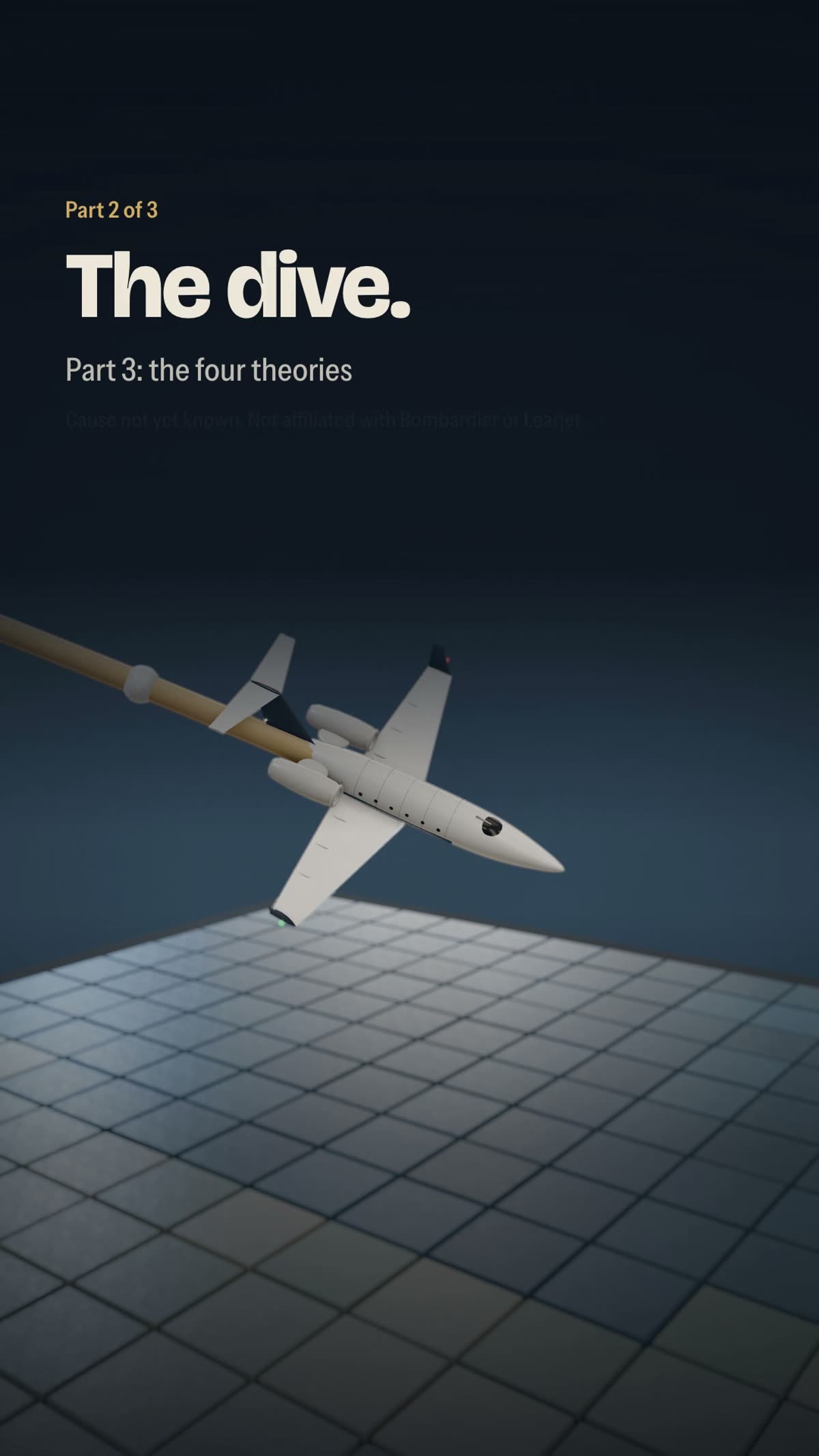
According to the track review, within about 16 seconds of the nose dropping, the jet was descending at 20,000 feet per minute, pitched about 22 degrees nose down at around 540 knots, close to Mach 0.9. Then it began to spiral to the right. On the radio, the bank was reported at 60 degrees. By the time it passed 18,000 feet, the review’s calculation put the descent rate above 50,000 feet per minute.
That last figure needs a caveat, and the caveat is revealing. The jet’s transponder, which reports its vertical speed to the ground, has a ceiling: its descent reading tops out near 32,640 feet per minute. In the data, the transponder’s number stalls there. Its scale had simply run out. The higher figure comes from working out the descent from successive GPS altitude points, which kept falling faster than the transponder could report. That is a calculation by an unofficial reviewer, not an official measurement.
The transponder’s number stalls near 32,640 feet a minute. Its scale had simply run out.
Physics made the final part of the fall more violent still. In the standard atmosphere, air at 8,750 feet is about two and a half times as dense as air at 35,000 feet (roughly 0.94 against 0.38 kilograms per cubic metre). Aerodynamic load rises with air density, so at the same true airspeed, the airframe down low would have carried about two and a half times the load it felt up high.
The last altitude the jet reported was 8,750 feet. At the rate it was falling, that left a matter of seconds.
A dashcam recorded the end. The governor said the jet came down “like a missile.” Reports placed the wreckage feet from homes and inches from cars. No one on the ground was reported hurt.
What remains of the aircraft will matter for what comes next. One Learjet captain said energy of that kind breaks a fuselage apart, and that heavy components, such as engine parts, may still be found. Investigators have not said what they have recovered.
Part 2 of 3 · 1:10
The Dive
Follow the data: 20,000 feet a minute within seconds, a spiral to the right, and a descent so fast the transponder ran out of numbers.
Watch Part 2 on Instagram Follow CERAMICO
Read the transcript
How fast was this jet falling? So fast that its transponder ran out of numbers. Let's follow the data. Within sixteen seconds, one track review says, twenty thousand feet a minute. Diving twenty two degrees. Five hundred forty knots. Near Mach point nine. Then it spirals right. By eighteen thousand feet, the dive is past fifty. The transponder's number stalls near thirty two thousand. Its scale has run out. The GPS math keeps climbing, past fifty thousand, and the air gets thicker. Down low, the same speed means two and a half times the load. Last altitude report: 8,750 feet. A dashcam catches the end. The governor said, like a missile coming down. Feet from homes, reporters said. Inches from cars. No one on the ground was reported hurt. And the jet? One Learjet captain says energy like that breaks a fuselage apart. Heavy parts, like engine components, may still be found. So what caused it? There are four theories. One is already falling apart. Follow for part three.
Animated model, illustrative and not to scale.
III. Four theories, none proven
Within hours, explanations were circulating. Here are the four we have seen most often, who is behind each one, and where the evidence stood as of Monday morning. None of them is a finding. Each is an allegation or a hypothesis, and some contradict each other.
1 “It was shot down”
Status: no supporting evidence
This is the theory that spread fastest online. A local official did call the site a crime scene. But no official has alleged a crime, and no reported evidence supports a shootdown. Of the four, it is the one already falling apart.
2 The tail
Status: disputed
One aviation site says stills from dashcam video appear to show the horizontal stabilizer, the small wing at the tail, missing as the jet fell. Another report says the tail looks intact. Officially, no one has said either way.
It matters because of how an aircraft balances. On a jet like this, the horizontal stabilizer is what holds the nose up. Without it, nothing does.
3 The storm
Status: hypothesis
A Learjet captain has suggested that turbulence inside the storm could have damaged the jet. The crew did report moderate turbulence, and tracking suggests the aircraft passed through a strong cell. Whether that turbulence damaged the structure is something only the wreckage can show.
4 The ice
Status: hypothesis, with a counterpoint
A pilot whose analysis was shared by the investor Bill Ackman argues that the Learjet 60’s wing is particularly sensitive, and that ice, thin air at altitude and high engine power together can lead to a stall and a sudden, violent roll known as a snap roll. A safety expert has also raised the possibility of a stall.
There is a counterpoint. The crew reported clear ice at about minus 47 degrees. Clear ice usually forms at far warmer temperatures, much closer to freezing, according to FAA guidance for pilots. That does not rule ice out, but it is a question the ice theory has to answer.
Part 3 of 3 · 1:10
Four Theories
Shot down, the tail, the storm, the ice: who is behind each theory, where the evidence stands, and how investigators will settle it.
Watch Part 3 on Instagram Follow CERAMICO
Read the transcript
What caused this jet crash? The internet says it was shot down. Here are all the four theories. Theory one, shot down. A local official called the site a crime scene, but no official alleges a crime, and no evidence supports a shootdown. Theory two, the tail. One aviation site says dashcam stills appear to show the stabilizer missing. Another report says it looks intact. Officially, nobody said. It matters because without the stabilizer, nothing holds the nose up. Theory three, the storm. A Learjet captain says turbulence could have damaged the jet. Theory four, ice. A pilot whose analysis Bill Ackman shared calls this wing particularly sensitive. Ice, thin air, high power, and it can stall and snap roll. A safety expert also raises a stall, but clear ice usually forms far warmer. Here's how it's gonna get settled. If the tail left early, it could land miles from the crater. The NTSB's process usually takes twelve to twenty four months. Until then, four theories. No verdict. In memory of the nine.
Animated model, illustrative and not to scale.
IV. How it gets settled
Investigators have evidence the internet does not, and the wreckage is the clearest of it. If the tail separated early in the dive, it would have fallen on its own path and could land miles from the crater. If it is found at the main site with the rest of the aircraft, the tail theory weakens. Signs of structural damage, of ice, and of how the aircraft was being flown will be weighed against weather data, maintenance records and any recorded data that is recovered.
The NTSB’s full process usually takes 12 to 24 months, and the agency typically publishes a preliminary report of facts, not causes, first. Until then: four theories, and no verdict.
What we chose not to publish
We have not named anyone aboard. We have not used the crew’s final radio words. We have left out claims that the aircraft broke up in the air, and reports of damage to power and water service, because we could not confirm them. If that changes, we will say so on this page, with the date.
In memory of the nine.
Watch the series on Instagram
All 3 parts, as published on CERAMICO’s Instagram.


Sources
Every line in the film was checked against these sources by an independent fact-checker before publication. Theories are attributed and are not findings.
- FAA, Aeronautical Information Manual, chapter 7 section 1 (meteorology and icing)
- NBC News: Jet crashes in Florida with nine people on board
- PBS NewsHour: All 9 people aboard a jet that crashed in Florida have died, transportation secretary says
- CNN via KESQ: Authorities investigating after plane crashes in Palm Beach County, Florida
- ABC News: Learjet with 9 aboard crashes in Palm Beach, Florida
- CBS News Miami: Texas jet crash in Florida
- CNBC: Jet nosedives, erupts into fireball near busy roadway in South Florida
- WPTV: Incident reported near Military Trail and 10th Avenue, Greenacres
- CBS12: Weather could have played a role in Greenacres plane crash, aviation expert says
- AVweb: Nine killed in Florida Learjet accident
- AeroTime: Florida Learjet crash, nine killed; icing and turbulence
- AeroCorner: Learjet 60 crash in Greenacres, Florida
- Flightradar24 on X: flight track summary
- VisaVerge: Track shows sudden dive after level flight at FL350 (unofficial track review)
- VIN News: Pilot analysis of the Palm Beach Learjet crash
- Pulse: Dashcam footage of the final seconds
- Wikipedia: Mach tuck (background on high-speed handling)
Updates and corrections
- First published. We will update this article after the NTSB briefing and note every change here.
See an error? Tell us. We correct promptly and say what changed. Our corrections policy.
Disclosure
Nothing in this article or its films is official. CERAMICO is an independent publisher. This work is not produced, reviewed, endorsed or sponsored by the National Transportation Safety Board, the Federal Aviation Administration, Bombardier, Learjet, the aircraft’s owner or operator, the families of those aboard, or any government agency or official.
No cause has been determined. All causes, theories and characterizations of events discussed here are alleged and unproven. They are attributed to the people and outlets that advanced them, and they are reported so readers can weigh them, not because CERAMICO endorses any of them.
Estimates are labeled. Flight-path figures marked as coming from a track review are from an unofficial analysis. The flight path shown in the films is an estimate built from reported data points; no raw positions have been published. The animations are illustrative models and are not to scale.
Facts can change. Facts as of Monday morning, 2 November 2026, before the NTSB’s first scheduled briefing. We will update this page as official information is released and log each change above.
Company and product names are used only to identify the aircraft. CERAMICO is not affiliated with any brand named.
Keep reading

The ball in the can: how a rattling piece of plastic gives Guinness Draught its head
Shake an empty can of Guinness Draught and a plastic ball rattles. It goes in with no beer and barely any pressure. The sealed can does the rest.

The penalty for turning left: how UPS taught its routing software to put a price on risk
UPS trucks are famous for not turning left. The truth is subtler: UPS built software that makes a left cost more, then lets the math decide.

Sticky only at the dots: the weak glue behind the Post-it Note, and why letting go is the point
Most glue tries to grab as much surface as it can. The adhesive Spencer Silver invented at 3M did the opposite, and it took years for anyone to see why that was useful.