Health · Child safety
Bitter on purpose: why some coin batteries taste awful, and why the taste is only a backup
Duracell coats some of its coin cells with a bitter agent so a child spits them out. To see why that matters, and why it is not enough, you have to know what a swallowed coin cell does.
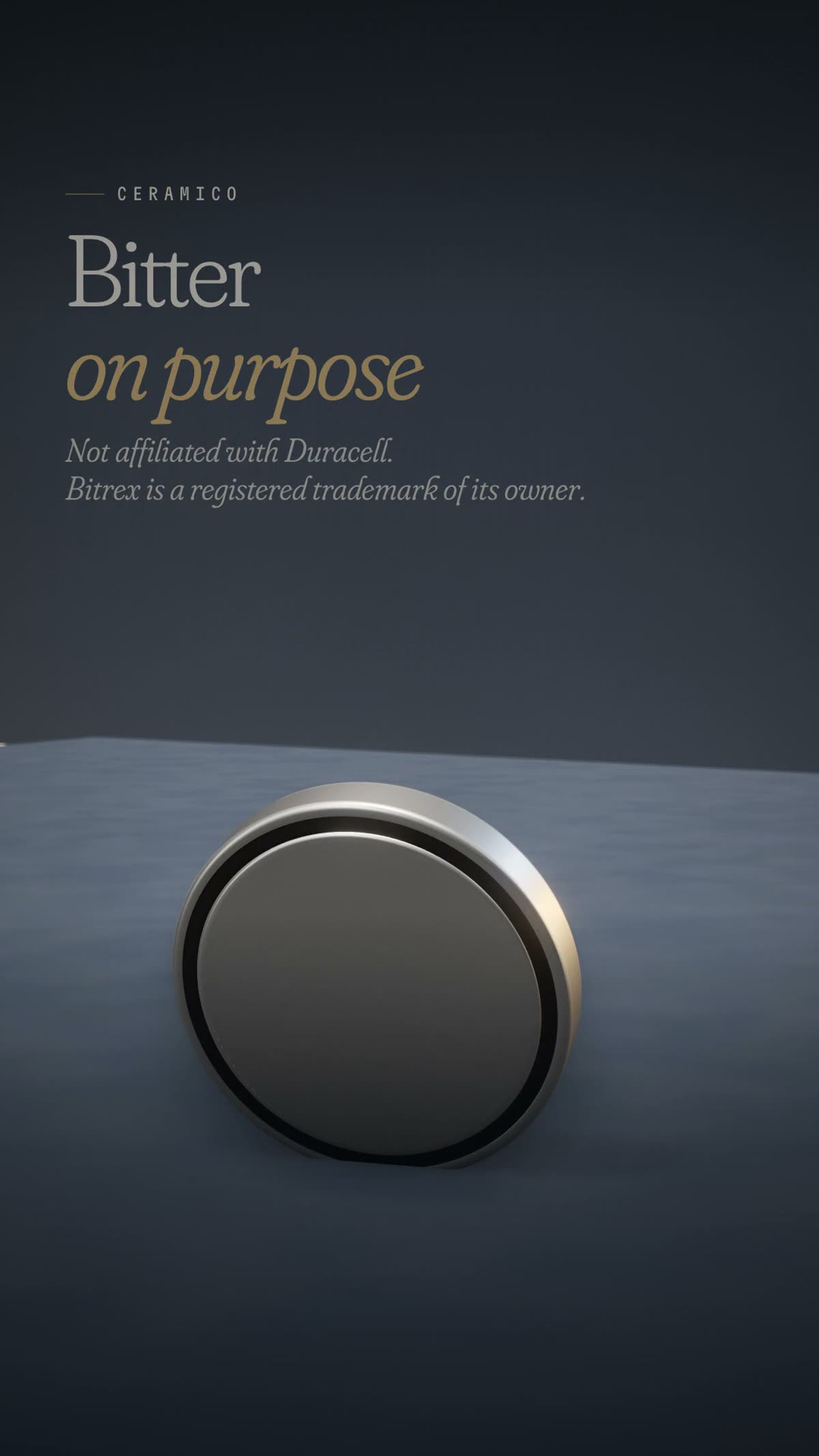 Watch the film · 1:09
Some of Duracell’s coin batteries are coated with one of the bitterest substances known. The awful taste is deliberate. It is also, in the words of a Duracell statement quoted by the American Academy of Pediatrics, “another line of defense.”
Coin cells are the flat, shiny batteries that power small gadgets; Apple, for one, names Duracell’s bitter-coated 2032 as an example battery for its AirTag. They are small, glossy and coin-like, which is exactly the problem. To understand why a battery maker would make its product taste terrible on purpose, you first have to understand what a swallowed coin cell does, because the real danger is not what most people assume.
By the numbers
- Duracell coin sizes with bitter coating
- 2032, 2025, 2016
- Diameter of those coin cells
- 20 mm
- Diameter of a US nickel
- 21.21 mm
- Serious burns can occur in
- as little as 2 hours
- US deaths, 2011 to 2021 (CPSC)
- 27
- Estimated US emergency room injuries, 2011 to 2021 (CPSC)
- 54,300
- Reese’s Law signed
- August 16, 2022
Coated sizes and cell diameter per Duracell. Nickel diameter per Wikipedia; the National Capital Poison Center gives 21 mm. Burn timing per the National Capital Poison Center and the US Consumer Product Safety Commission. Death and injury figures are CPSC estimates for 2011 to 2021.
The danger is what it does, not what is inside
The popular picture is a battery that leaks acid. The National Capital Poison Center lists the mechanisms of battery injury “in the likely order of importance,” and leakage comes second. First is the “generation of an external electrolytic current.” Great Ormond Street Hospital in London puts it plainly: the injury is “not usually due to chemicals leaking from the battery.”
Size is what sets up the problem. The coated Duracell cells are 20 millimeters across, just under a US nickel. The poison center says the 20 mm lithium coin cell “is most frequently involved in esophageal injuries,” and adds that “smaller cells lodge less frequently.” The UK Office for Product Safety and Standards (OPSS) agrees: “Their larger diameter means they are more likely to become lodged in the oesophagus.” Not every swallowed battery sticks; the OPSS review reports that more ended up in the stomach than in the oesophagus. But a battery that moves freely, according to the poison center, does not cause focal tissue damage. Getting stuck is what matters.
Once a coin cell is lodged, the OPSS explains, “saliva or other bodily fluid may allow electrical conduction between the electrodes.” Wet tissue touches both sides of the battery, and current flows through it. That current splits water. According to the poison center, it leads “to the accumulation of hydrogen gas and hydroxide ions at the negative pole.” The hydroxide is the same family of alkali as caustic soda: the poison center’s review cites research describing “sodium hydroxide and hydrogen gas generated at the negative electrode,” and MedlinePlus lists drain cleaners among household products that can contain sodium hydroxide. Great Ormond Street describes the battery releasing “a substance like caustic soda, which is a strong alkali that can burn through tissue.”
The speed is what makes it so dangerous. “Batteries lodged in the esophagus may cause serious burns in as little as 2 hours,” the poison center says, and the US Consumer Product Safety Commission (CPSC) warns that these batteries “can burn through a child’s throat or esophagus in as little as two hours.” A 2010 study in Pediatrics by Litovitz and colleagues found that severe burns with lasting effects “occurred in just 2 to 2.5 hours.” Two hours is not a safe window; laboratory work cited by the poison center shows injury beginning well before that.
Worse, the emergency can be silent. The same study reported that most fatal ingestions were not witnessed, and the poison center warns that “patients with a battery in the esophagus may be asymptomatic initially.” Used batteries are not harmless either: in the poison center’s words, “even used batteries pose a danger on ingestion.”
A defense that starts in the mouth
Duracell’s idea is to intervene earlier, before the battery is swallowed at all. On its 2032, 2025 and 2016 lithium coin cells, the company applies what it calls “a transparent, non-toxic, bitter coating designed to help discourage swallowing.” Its safety page says the coating is “double-sided” and “contains Bitrex,” a brand of denatonium benzoate. Duracell announced the coating in 2020, and in a 2021 announcement with the American Academy of Pediatrics described it as covering “our most popular lithium coin battery sizes.”
Denatonium is a sensible choice for the job. Guinness World Records states that “the bitterest-tasting substances are based on the denatonium cation,” and the poison center describes denatonium benzoate as “among the most bitter substances known to man.” The goal, in the OPSS’s summary of how bitterants are meant to work, is that a child will be repulsed by the taste and “more likely to spit it out rather than ingest it.”
The film · 1:09
Bitter on Purpose
A clay-style model showing how a lodged coin cell makes hydroxide in wet tissue, and why Duracell’s bitter coating works only in the mouth.
Watch more on Instagram Follow CERAMICO
Read the transcript
Duracell makes some of its coin batteries taste awful. On purpose. The main danger isn't what's inside. It's what this coin does. 20 millimeters, just under a nickel. Big enough to lodge in a child's food pipe. Once stuck, wet tissue touches both sides, so current flows. That current splits water, making hydroxide at the negative side. Drain-cleaner chemistry. So it can burn badly in as little as 2 hours. Duracell's idea starts earlier: the mouth. Its most popular coin cells wear clear Bitrex, among the bitterest substances known. The goal: one taste, then spit. Even the pack needs scissors. But bitter only works in the mouth. Swallowed, coated cells can still burn. Experts say it's not proven bitter coatings stop swallowing. They're a backup. Real protection: secure battery doors. New and used cells out of reach. If a child may have swallowed one, go to the ER now. Don't wait for symptoms. Send this to anyone with a toddler, so they know why
Animated model, illustrative and not to scale.
The packaging is part of the same strategy. Duracell says its double blister “requires scissors” to get the battery out. That is no longer unusual: under Reese’s Law, which President Biden signed on August 16, 2022, the child-resistant packaging requirement for separately sold button and coin batteries took effect on February 12, 2023, according to the Federal Register. Duracell is not alone with a bitter cell, either. The OPSS reports that Energizer brought a coin cell with a bitterant and a blue saliva dye to the US market in April 2024.
Why bitter is only a backup
A taste works only while the battery is in the mouth. Once it is swallowed, the chemistry takes over, and the coating does not change it. An Energizer patent application states that a coin cell coated with a bitterant “will still cause an electrolysis reaction in the esophagus or stomach and cause severe injury.” Duracell’s own safety page still says: “If your child swallows a battery, go to the emergency room.”
A taste works only while the battery is in the mouth.
Nor is it proven that the taste stops children swallowing batteries in the first place. The UK regulator’s 2025 review is careful: “Although there is some evidence of bitterant and saliva-staining dye efficacy, their effectiveness in reducing button battery ingestions is not proven.” The National Capital Poison Center, writing about taste-aversive agents in general, says “there is no evidence indicating that their usage decreases the incidence or severity of poisonings,” and advises: “Do not rely solely on taste aversive agents to prevent unintentional ingestions.” The OPSS quotes an older recommendation that such agents “should augment but not replace proven methods of poison prevention.”
Even batteries designed specifically to reduce injury do not change the emergency. Contemporary Pediatrics reported in 2026 on a study of a protective titanium-based cell that “still generated alkaline hydroxide,” with the authors concluding that “standard emergency evaluation and treatment should continue for all suspected button battery ingestions.”
What real protection looks like
The protections that experts lean on are mechanical and behavioral. The US mandatory standard described by the CPSC requires battery compartments that need “the use of a tool such as a screwdriver or coin” or “at least two independent and simultaneous movements to open by hand.” The warning now required on US battery packaging is blunt: “KEEP new and used batteries OUT OF REACH OF CHILDREN.”
And if a battery may have been swallowed, the authorities are united on urgency. The CPSC says to “immediately take children who are suspected of having swallowed button cell or coin batteries to the nearest emergency department.” The full emergency guidance, including hotline numbers and the poison center’s exact wording on when honey may be given on the way to the hospital, is reproduced on this page.
Why it matters
A bitter coating is a clever piece of design aimed at the one moment a parent cannot always watch: a small hand, a shiny disc, a mouth. It may help. But the more important lesson is the physics underneath it. A coin cell becomes dangerous when it is stuck in wet tissue with current flowing, and nothing about its taste changes that. Bitter is a backup. Secure battery doors, new and used cells kept out of reach, and a fast trip to the emergency room are the real protection.
Sources
Every line in the film was checked against these sources by an independent fact-checker before publication. Company claims are attributed to the company that made them.
- Duracell: Lithium coin battery safety
- Duracell: Duracell debuts breakthrough child safety feature for lithium coin batteries
- Business Wire: Duracell child safety feature release (2020)
- Duracell Middle East: Lithium coin battery safety
- Duracell US homepage
- National Capital Poison Center: Button battery
- National Capital Poison Center: Button battery ingestion triage and treatment guideline
- National Capital Poison Center: Mechanism of battery-induced injury
- National Capital Poison Center: Taste aversive agents
- US CPSC: Making families safer from button cell or coin battery dangers
- Federal Register: Safety standard for button cell or coin batteries, 88 FR 65296
- UK Office for Product Safety and Standards: Emerging technologies in the field of button battery safety (2025)
- PubMed: Litovitz et al., Emerging battery-ingestion hazard (Pediatrics, 2010)
- NCBI E-utilities: Litovitz et al. 2010 abstract
- Google Patents: US 2024/0421389 A1, Lithium coin cell batteries with polymer and aversive-agent coating (Energizer)
- Google Patents: US 10,637,011 B2, Battery cell with safety layer (Duracell)
- Frontiers in Pediatrics: Edible oils attenuate button battery-induced injury in porcine esophageal segments (2020)
- Frontiers in Pediatrics: Esophageal diameter as a function of weight in neonates, children and adolescents (2022)
- Contemporary Pediatrics: Child-protective button battery reduces tissue injury but does not change emergency management
- American Academy of Pediatrics: Duracell and the AAP join forces
- Guinness World Records: Bitterest substance
- MedlinePlus: Sodium hydroxide poisoning
- Duracell: DL2032 lithium/manganese dioxide battery data sheet (1997)
- Mouser: Duracell LI2032 data sheet
- Apple Support: How to replace the battery in your AirTag
- Children’s Hospital of Philadelphia: Swallowed button battery is an emergency
- Great Ormond Street Hospital: Button batteries, using them safely
- NHS England: Risk of death and serious harm from delays in recognising and treating ingestion of button batteries
- Child Accident Prevention Trust: Button batteries
- CBS17: Button batteries considered a danger to children
- Wikipedia: Nickel (United States coin)
- US Mint: Coin specifications
- Wikimedia Commons: Duracell logo
Updates and corrections
- First published.
See an error? Tell us. We correct promptly and say what changed. Our corrections policy.
Disclosure
This is an independent explainer. CERAMICO is not affiliated with, sponsored by, or speaking for any company, brand, agency or person named in this story, and nothing here is official.
Claims are attributed. Where a figure or description comes from a company or an expert, we say so. CERAMICO is not affiliated with Duracell. Duracell and Bitrex are registered trademarks of their respective owners, and brand names identify the products only. The animation is an illustrative model; no child or real anatomy is shown. This article is general information, not medical advice. In an emergency, call your local emergency number.
Animations are illustrative. Our films use clay-style 3D models. They are not to scale and are simplified to show how something works.
Trademarks and product names belong to their owners and are used only to identify what we are describing.
Keep reading
The ball in the can: how a rattling piece of plastic gives Guinness Draught its head
Shake an empty can of Guinness Draught and a plastic ball rattles. It goes in with no beer and barely any pressure. The sealed can does the rest.

The penalty for turning left: how UPS taught its routing software to put a price on risk
UPS trucks are famous for not turning left. The truth is subtler: UPS built software that makes a left cost more, then lets the math decide.

Sticky only at the dots: the weak glue behind the Post-it Note, and why letting go is the point
Most glue tries to grab as much surface as it can. The adhesive Spencer Silver invented at 3M did the opposite, and it took years for anyone to see why that was useful.