Design · How it works
Amazon’s warehouse shelves are a mess on purpose, and the mess is what makes them fast
In Amazon’s robotic warehouses, a cookbook can share a bin with socks. Scattering every product across many shelves gives the computer choices, and in 2015 Amazon rewrote how it makes them.
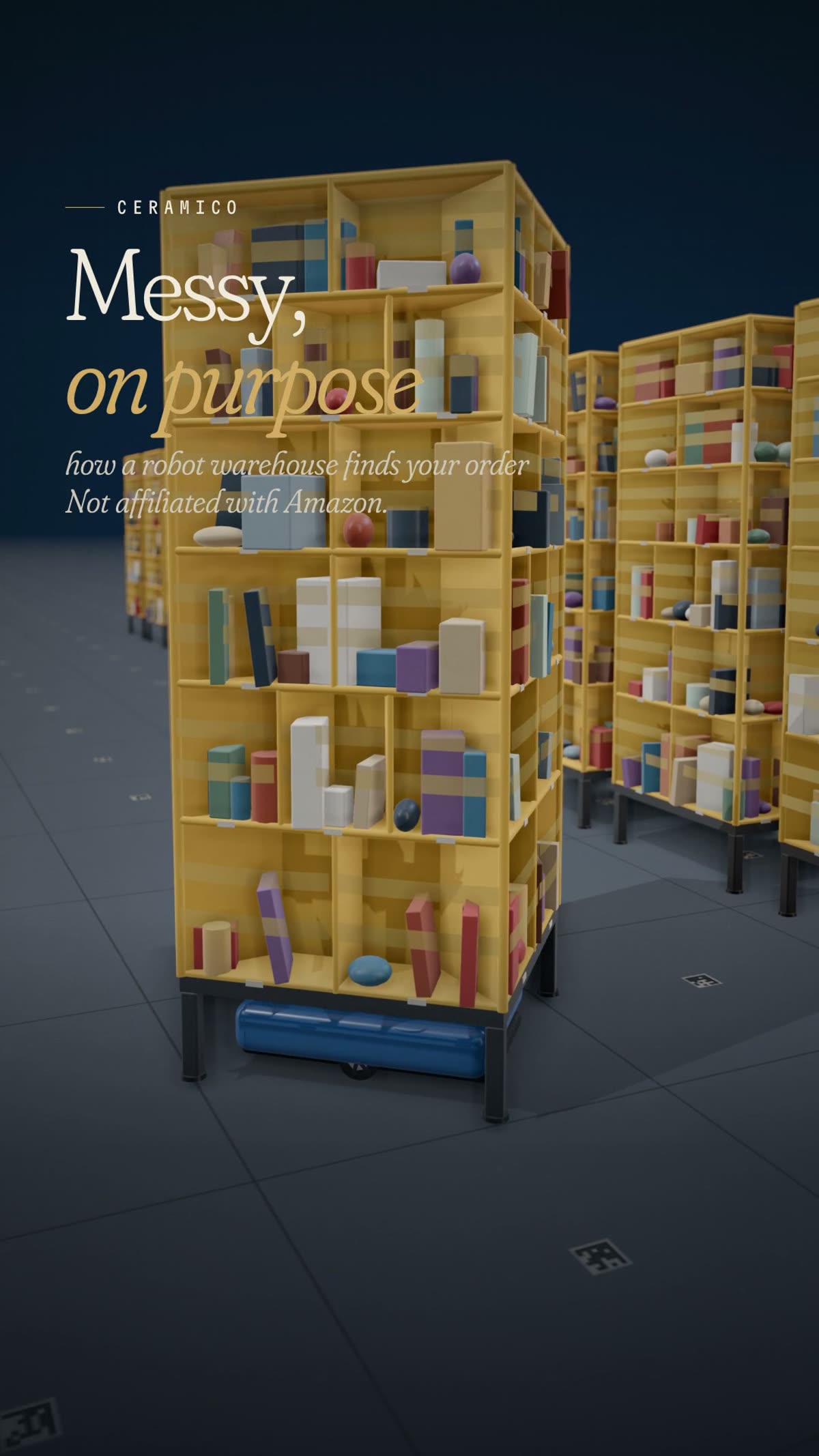 Watch the film · 1:07
Open a bin in one of Amazon’s robotic warehouses and you might find a cookbook, a pair of socks and a phone charger side by side. Nobody made a mistake.
Amazon says so plainly. “All of the inventory at Amazon fulfillment centers is stowed randomly,” reads its own guide to warehouse tours, which describes tall yellow pods that “stack bins full of unrelated items, all of them tracked by computers.” In a 2023 peer-reviewed paper, a team of Amazon researchers gave the reason. The company’s “random-stow policy,” they wrote, spreads the same product across many different shelves “to allow for picking flexibility.”
It sounds like the opposite of how a good stockroom should work. But the system runs on three simple moves, and the mess is the point of the second one.
By the numbers
- Bins on one pod
- up to 40
- Manual stows per year
- over 14 billion
- Kiva Systems purchase (2012)
- $775 million
- Drive travel per item after 2015 redesign
- 62% less
- Drives required after redesign
- 31% fewer
- Savings, per Amazon’s researchers
- half a billion dollars
- Robots deployed, all types (2025)
- 1 million+
The 62%, 31% and savings figures are Amazon’s own results, published in a peer-reviewed paper by Amazon staff but not independently audited. The robot count covers all robot types, not only shelf-carrying drives. Bin counts vary by pod design.
Move one: no fixed home
The shelves in question are pods. An Amazon Science article describes a pod as “akin to a big bookcase, made of sturdy yellow fabric,” with up to 40 cubbies called bins, each with strips of elastic across the front to keep things from falling out. Designs vary, and a 2025 Amazon Robotics paper describes pods with even more bins.
When new stock arrives, a worker called a stower fills them. The Amazon researchers describe the step in one line: “the associate finds an open space in the pod and stows the item.” There is no section for books and another for socks. An item goes wherever it fits. An Amazon representative at its Reno warehouse explained the appeal to a local business paper in 2016: “Random stow allows us to optimize the cubic space inside a building.”
Random does not mean careless. Amazon’s tour guide says the stower looks for suitable space for each item, and a patent Amazon was granted in 2025 describes machine learning that proposes a set of candidate bins. What random means here is that no product has a fixed home.
That only works if the computer knows exactly where everything went. The shelf can be chaos; the map cannot. Each placement is logged. Associates once had to hand-scan a bin location after stowing each item, Amazon says, but machine learning now detects where an item went automatically. By the Amazon Robotics paper’s count, people perform this stowing step more than 14 billion times a year.
Move two: scatter the copies
Here is the trick. The same product is not stowed in one place. Amazon’s Australian operation describes it this way: “Instead of storing the same products together, products are dispersed throughout the pods in a method known as Random Stow.” The researchers put it more technically: each pod carries a mixture of items, and the inventory of each item is spread over multiple pods.
That scatter is not a side effect of filling gaps. It is the policy. And it pays off at the moment you click “buy.”
The film · 1:07
Messy on Purpose
A clay-animated tour of Amazon’s random stow, from a worker tucking an item into any open bin to a robot carrying the shelf to a picker.
Watch more on Instagram Follow CERAMICO
Read the transcript
Amazon's warehouse shelves are a total mess. On purpose. One bin might hold a cookbook, socks and a charger. So how do they find your order? Three moves. One. When stock arrives, a worker tucks each item into any bin with room. It's logged, so the computer knows its bin. The shelf can be chaos. The map can't. Two, the trick. The same product gets scattered across many shelves. Three. You order. In many warehouses, a flat robot slides under a yellow shelf, lifts it, and drives it to a person. A light marks the exact spot. But which shelf? Your item often sits on many, so the computer gets to choose. In 2015, Amazon rewrote that choice. Robots drove less than half as far per item. Amazon needed nearly a third fewer robots. The mess isn't a mistake. It's what gives the computer options. Send this to the friend whose messy desk is a system. At Amazon, it is. That's exactly why
Animated model, illustrative and not to scale.
Move three: the shelf comes to you
In many of Amazon’s warehouses, workers do not walk the aisles to find your order. The aisles come to them. Amazon bought the robot maker Kiva Systems in 2012 for about $775 million in cash. Kiva is now Amazon Robotics, and its drives do the carrying.
The robot is small and flat. According to Amazon Science, its Hercules drive “slides under the pod, which weighs up to 1,000 pounds,” and lifts it off the ground. Drives find their way by reading a grid of 2D barcodes on the floor with a downward-facing camera, then carry the pod to a pick station at the edge of the storage field. There, a light shows the worker the item’s exact location in the pod. The person picks the item and scans it. Robots fetch; in these buildings, people still pick.
This is not how every Amazon building works. Amazon says Hercules fetches goods in “certain fulfillment centers.” Its newer Sequoia system, introduced in 2023, stores inventory in totes rather than fabric pods, and sortation centers and delivery stations do not hold inventory at all.
The shelf can be chaos; the map cannot.
Why the mess pays
Now the scatter earns its keep. Because the product you ordered often sits on many pods, the computer gets to choose which one to bring. In the researchers’ words, “The picking algorithm needs to decide which specific units of inventory on which pods should be picked.”
In 2015, Amazon’s modeling and optimization team redesigned that algorithm, and it went into production in 2017. According to their paper, the new version “reduced the distance traveled by drives per unit picked by 62% without negative operational impact.” Put plainly, robots drove less than half as far for each item. Amazon then needed 31 percent fewer drives in its robotic fulfillment centers, which the authors say amounted to half a billion dollars in savings. The paper also reports that the algorithm made it more likely that a worker could pick several items from one pod. These are Amazon’s own numbers, refereed by a journal but not independently audited.
Without random stow, none of that choice would exist. If every copy of a product sat on one pod, there would be only one pod to send.
The fleet has kept growing. In 2025, Amazon said it had deployed its millionth robot, a total that counts every type, not just shelf carriers. In June 2026, The Robot Report described a next-generation Proteus robot that understands natural-language commands. The yellow pods remain, and a 2025 Amazon Robotics paper describes a robot built to stow items into them.
So the next time a messy desk gets defended as “a system,” there is a fair counterexample on a very large scale. At Amazon, the mess is the system, as long as something keeps a perfect map of it.
Sources
Every line in the film was checked against these sources by an independent fact-checker before publication. Company claims are attributed to the company that made them.
- Amazon: The story behind Amazon’s next generation robot
- Amazon: Hercules robot
- Amazon: An employee shares fulfillment center jobs
- SUFE academic newsletter: Velocity-based stowage policy research
- Amazon Ads: Brand usage guidelines
- arXiv: Stow, robotic packing of items into fabric pods (Amazon Robotics, 2025)
- Wikimedia Commons: Amazon logo (2024)
- Wikimedia Commons: Amazon logo (2012)
- INFORMS Journal on Applied Analytics: Algorithm for robotic picking in Amazon fulfillment centers (2023, PDF)
- MIT DSpace: Velocity-based stowage research
- IDEAS/RePEc: Algorithm for robotic picking in Amazon fulfillment centers (abstract)
- Interesting Engineering: Amazon deploys 1 millionth robot (2025)
- Northern Nevada Business Weekly: A place for everything (2016)
- Amazon: Global brand guidelines (PDF)
- Google Patents: US 12,373,777 B1, directed storage guidance in inventory bins (Amazon)
- Google Patents: US 7,402,018, inventory system with mobile drive unit (Kiva Systems)
- Amazon press center
- IEEE Spectrum: Stowing is a beautiful problem that Amazon is solving with robots (2023)
- TechCrunch: Amazon acquires Kiva Systems for $775 million in cash (2012)
- Tech Xplore: Amazon develops algorithm to improve collaboration between robots and humans (2023)
- Amazon UK: Look inside an Amazon fulfilment centre
- Amazon UK: 4 cool facts about Amazon robots
- Amazon Australia: Robotics fulfilment centre in Western Sydney nears completion
- Amazon Australia: Behind the scenes at the Western Sydney robotics fulfilment centre (2023)
- Amazon: Fulfillment center photo tour
- Amazon: Amazon introduces new robotics solutions (2023)
- Amazon: Amazon deploys over 1 million robots (2025)
- Amazon: Robots that sort, lift and carry packages
- Amazon: Inside Amazon’s fulfillment centers, what to expect on a warehouse tour
- Amazon: Introducing Blue Jay and Project Eluna (2025)
- AJOT: Amazon’s warehouses, the power of randomness
- Amazon Science: Amazon’s tiny robot drives do the heavy lifting (2022)
- Amazon Science: How Amazon Robotics researchers are solving a beautiful problem (2022)
- Canberra Times: Inside the largest warehouse in Australia (2022)
- GeekWire: A first-hand look at Amazon’s Sequoia system (2023)
- U.S. SEC: Amazon.com to acquire Kiva Systems (2012)
- The Robot Report: Proteus gets natural-language ability (2026)
Updates and corrections
- First published.
See an error? Tell us. We correct promptly and say what changed. Our corrections policy.
Disclosure
This is an independent explainer. CERAMICO is not affiliated with, sponsored by, or speaking for any company, brand, agency or person named in this story, and nothing here is official.
Claims are attributed. Where a figure or description comes from a company or an expert, we say so. CERAMICO is not affiliated with Amazon. Brand names identify the company only. Performance figures are Amazon’s own. The animation is an illustrative model, not to scale.
Animations are illustrative. Our films use clay-style 3D models. They are not to scale and are simplified to show how something works.
Trademarks and product names belong to their owners and are used only to identify what we are describing.
Keep reading

The ball in the can: how a rattling piece of plastic gives Guinness Draught its head
Shake an empty can of Guinness Draught and a plastic ball rattles. It goes in with no beer and barely any pressure. The sealed can does the rest.

Coffee by barcode: how a Nespresso Vertuo reads its recipe, then brews by spinning
Before a Vertuo machine makes a single drop, it reads a ring of code under the capsule’s rim. Then it does something classic Nespresso never does: it spins the coffee.
No glue, no clips: the hidden tube and tiny number that hold LEGO® bricks together
A 1958 patent moved a hollow tube to exactly the right spot. Add plastic that gives a little and moulds the LEGO Group says are accurate to about 0.005 mm, and you get a grip that has lasted nearly seven decades.