Design · How it works
Coffee by barcode: how a Nespresso Vertuo reads its recipe, then brews by spinning
Before a Vertuo machine makes a single drop, it reads a ring of code under the capsule’s rim. Then it does something classic Nespresso never does: it spins the coffee.
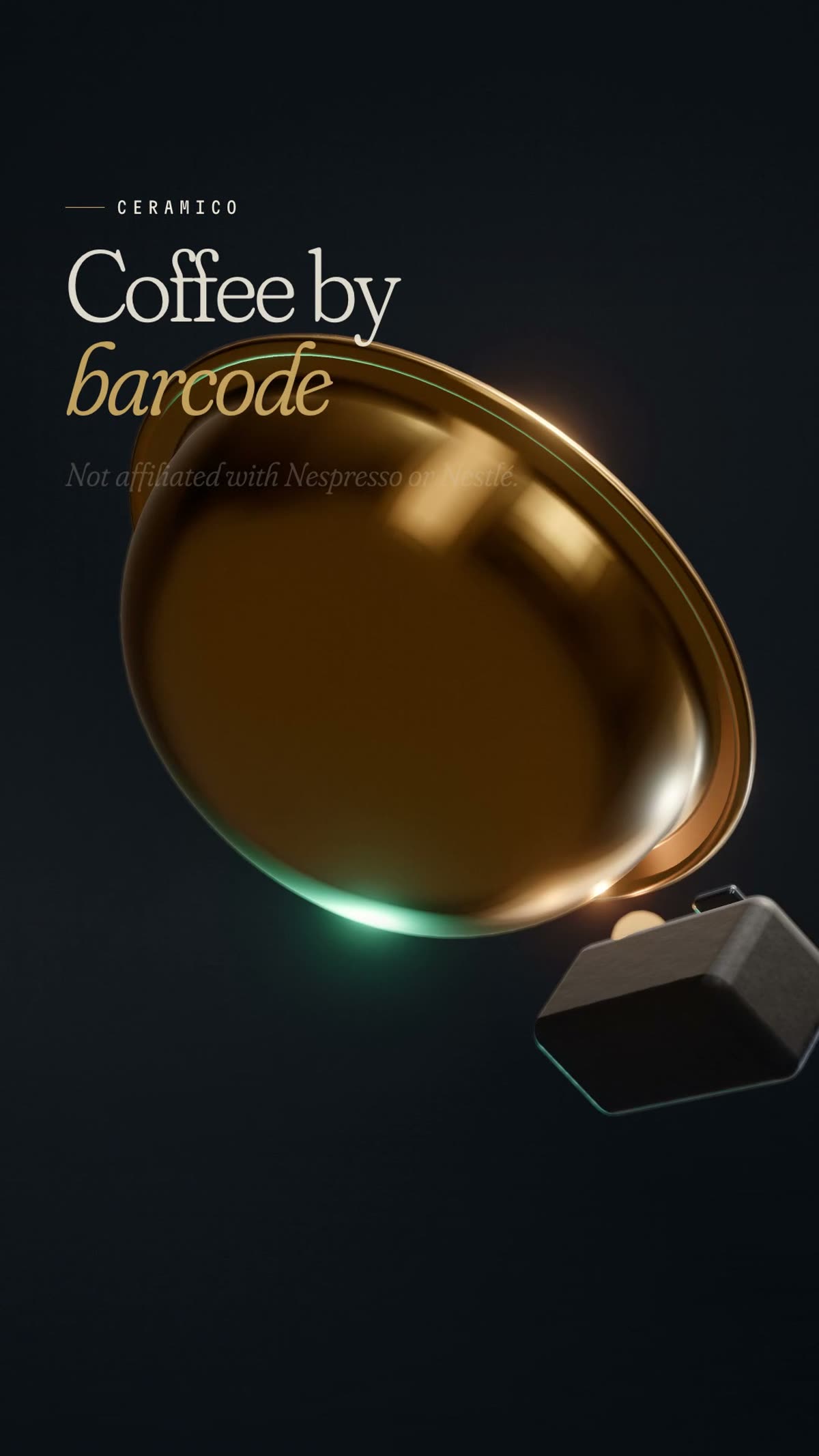 Watch the film · 1:06
Drop a capsule into a Nespresso Vertuo and close the lid. Before any water moves, the machine turns the capsule and reads it, like a cashier scanning a tin of beans.
The code it reads is not a price. It is a set of instructions. And once the machine has read them, it brews in a way that classic Nespresso never does: it spins the capsule, fast enough that the spin itself does the work a pump does in other machines.
By the numbers
- Vertuo launched (US and Canada)
- February 2014
- Vertuo capsule spin, per Nespresso
- up to 4,000 rpm
- Typical mid-range washing machine spin
- 1,400 rpm
- Original line pump rating
- 19 bar
- Vertuo cup sizes, espresso to carafe
- 40 to 535 ml
- Cup sizes on the 2026 Vertuo Up
- 8
- Recycled aluminium in Vertuo capsules
- 80 %
Spin speed is Nespresso’s own figure; licensed machine makers quote up to 7,000 rpm. The 19 bar figure is the pump’s rating, not a measured pressure at the coffee. Washing machine figure per Whitegoods Help. Launch date per Wikipedia and FoodNavigator.
A ring of code under the rim
Turn a Vertuo capsule over and look under the flat rim. You will see a ring of thin light and dark marks. Nespresso’s product pages describe “a barcode on the rim of the capsule,” and Nespresso’s FAQ explains its job: “The Vertuo system reads the barcode on the capsules to identify which coffee the consumer is preparing.”
Nespresso lists the brewing phases in order, and reading comes first. In phase one, “the capsule is read and all extraction parameters are defined and adjusted.” Phase two is infusion, when “the system injects water into the capsule.” A 2026 teardown of the Vertuo Next published by Hackaday found the same order in the electronics: the code goes to the machine’s microcontroller, after which brewing “is either commenced or cruelly halted if the code fails.”
How does a machine read a barcode it cannot see from above? It spins it past a reader. Hackaday describes the capsule being “spun around so that it can be read by the optical reader,” which it identifies as a photodiode and an infrared LED. A Nestlé patent for the code system describes the same idea: symbols “sequentially readable by a reading arrangement of an external reading device while the capsule is driven in rotation,” measured from the underside of the rim. In one embodiment described in that patent, the light is infrared at 850 nanometers, which means the “small light” doing the reading is invisible to you. The patent also describes one possible layout: 160 one-bit marks, each covering 2.25 degrees of the circle, with the sequence repeated three to six times around the rim, so a single turn reads it more than once. That is a patent embodiment, not a published spec of the capsules on sale today, but it gives a sense of how much information fits in a ring you can barely see.
What the code tells the machine
According to Nespresso, the code tells the machine how to “adjust the amount and temperature of the water, the time of infusion and the level of rotation of the capsule.” Put simply: the water, the heat, the timing and the spin. A large mug of coffee and a small espresso use the same machine and the same rim size; the patent describes capsules of different depths sharing “a same insertion diameter.” The barcode is what tells the machine which one it is holding.
That is why one machine can cover such a range. Nespresso’s Vertuo system page lists cup sizes from a 40 ml espresso to a 535 ml carafe, and the 2026 Vertuo Up lists eight sizes in all. Not every model reaches the top of the range: the compact Vertuo Pop lists sizes up to an XL coffee of 355 ml. The capsules, though, carry their recipe with them.
Which raises the obvious question. Why would coffee need a spin speed?
The film · 1:06
Coffee by Barcode
A clay-style cutaway of a Nespresso Vertuo capsule, showing the rim barcode being read and the spin that pushes water through the coffee.
Watch more on Instagram Follow CERAMICO
Read the transcript
Your Nespresso Vertuo reads a barcode before it makes a single drop. Not a price. Instructions. Then it does what classic Nespresso never does. Under the rim, a ring of tiny stripes. The capsule turns while a small light reads them. So the machine sets the water, the heat, the timing, and the spin. Wait. Why would coffee need a spin speed? Water flows in. The capsule whirls, thousands of turns a minute, more than twice a washing machine's spin. The spin flings water through the coffee and out tiny holes near the rim. Classic Nespresso? A pump rated 19 bar, about nineteen times the air around you, forces water through. Vertuo has no high-pressure pump. The spin is the pressure. Nespresso says the spin even builds that thick foam. So the barcode isn't a label. It's the recipe, from espresso to a whole carafe. Send this to the friend who thinks a pod is just coffee in foil. Every cup starts the same way:
Animated model, illustrative and not to scale.
The spin is the pressure
The Vertuo brews by spinning. Nespresso calls the system Centrifusion, and says the coffee is extracted at up to 4,000 revolutions per minute. (Breville and De’Longhi, which make Vertuo machines under license, both quote up to 7,000. Either way, it is thousands of turns a minute.) For comparison, Beko says the spin speeds in its washing machine range go “up to a maximum of 1600rpm,” and Whitegoods Help says “1400rpm has become the default for most mid-range machines.” Even Nespresso’s lower figure is more than twice the spin of a fast washing machine.
Spinning changes how water moves through the coffee. Nespresso’s own pages say only that the machine injects water into the capsule; Nestlé’s patents describe it entering through a central inlet. Once inside, the spin flings it outward. The patent describes “a gradient of pressure of liquid in the receptacle; such pressure increasing gradually from the centre towards the periphery.” Water is driven through the grounds from the middle toward the edge, and the coffee leaves through small openings near the rim. Home Grounds describes it exiting “through a series of punctures around the edge of the capsule.”
Compare that with the classic Nespresso machines, now sold as the Original line. Those have a pump. Nespresso lists the Inissia with a “19 bar Pressure pump.” By the US National Institute of Standards and Technology’s definitions, a bar is 100 kilopascals and standard atmospheric pressure is 101,325 pascals, so 19 bar is about nineteen times the air around you. That number is the pump’s rating, the most it can produce, not a measured pressure at the coffee; Nespresso does not publish the latter. A 1991 Nestlé patent for a closed cartridge describes its cover being “torn solely under the effect of the pressure of the extraction fluid.”
In a Vertuo, the spin is the pressure.
The Vertuo has no such pump. Nespresso’s spec table for the 2026 Vertuo Up lists “Pressure Pump: N.A. (centrifugal extraction system).” There is still a low-pressure pump to move water into the capsule, as Nestlé’s patent notes, but no high-pressure pump does the pushing. In a Vertuo, the spin is the pressure. One Nestlé patent gives the liquid pressure at the outlet areas as “between about 0.5 and 3 bar,” far below the Original pump’s rating.
Foam, and the recipe
Vertuo coffee is known for its thick head of foam. Nespresso credits the spin. Its FAQ describes crema as “a naturally formed foam of coffee and air, produced during the extraction process,” and says Vertuo crema can be thicker than on Original coffees “due to its unique Centrifusion system.” Nestlé’s patent adds a nuance: a restriction such as an exit valve “promotes the generation of a nice amount of crema,” so the spin is not working alone.
The system has been on sale since February 2014, when, according to Wikipedia and the trade publication FoodNavigator, Nespresso launched what it then called VertuoLine in the United States and Canada. In 2026 it is still current: the Vertuo Up product pages describe “Centrifusion brewing with automatic barcode recognition.” And the capsules themselves, Nespresso says, are made of 80 percent recycled aluminium.
Why it matters
The Vertuo turns a capsule into a small data carrier. An Original capsule carries no code. A Vertuo capsule tells the machine what to do with it, and the machine adjusts water, temperature, time and rotation to match.
It is also a neat piece of physics. Instead of forcing water through coffee with a pump, the Vertuo lets rotation build the pressure, rising from the center of the capsule to its rim. So the barcode is not a label. It is the recipe, and every cup starts the same way: with the machine quietly reading the rim before it pours a drop.
Sources
Every line in the film was checked against these sources by an independent fact-checker before publication. Company claims are attributed to the company that made them.
- Nespresso FAQ: Vertuo system, what do the bar codes in the capsules do?
- Nespresso FAQ (Australia): What do the bar codes on the Vertuo capsules do?
- Nespresso FAQ (Australia): Why is the Vertuo crema so dense?
- Nespresso FAQ (Thailand): Vertuo Pop specifications
- Nespresso: Vertuo, standards are meant to be broken
- Nespresso: Vertuo Up Pearl White (2026)
- Nespresso: Vertuo Up
- Nespresso: Vertuo Pop Aqua Mint
- Nespresso: Inissia (Original line)
- Nespresso (Germany): Vertuo capsule machine technology
- Nestlé Nespresso: Creating the premium large-cup coffee market with VertuoLine
- Google Patents: US 9,582,699 B2, Support and capsule for preparing a beverage by centrifugation
- Google Patents: US 9,268,984 B2
- Google Patents: US 8,512,784 B2, Method and device for controlled beverage production using centrifugal forces
- Google Patents: US 9,573,753 B2, Capsule and method for the preparation of a beverage by centrifugation
- Google Patents: EP 0 512 468 B1, Closed cartridge for making a beverage
- Hackaday: Repair and reverse-engineering of Nespresso Vertuo Next coffee machines
- Breville: Nespresso Vertuo (BNV220)
- De’Longhi: Vertuo Up ENV200W
- FoodNavigator: Nestlé targets $5bn coffee market with Nespresso ‘game changer’
- Wikipedia: Nespresso
- NIST: Guide to the SI, chapter 5, units outside the SI
- Beko UK: What does washing machine spin speed mean?
- Whitegoods Help: Washing machine spin speed efficiency
- Hunker: How fast does a washing machine spin clothes?
- Instacuppa: 20 bar vs 9 bar espresso, what pressure actually means
- Home Grounds: How does Nespresso work?
- Galaxus: Krups Nespresso CitiZ
- AJ Madison: Nespresso Inissia EN80S
- Tasting Table: Your Nespresso machine isn’t making an authentic espresso
- Alvinology: Nespresso launches Vertuo Up in Singapore
- Bloomberg Law: Nespresso, K-fee agree to end patent lawsuit over coffee pods
- Wikimedia Commons: Nespresso logo (wordmark)
- Wikimedia Commons: Nespresso wordmark SVG file
Updates and corrections
- First published.
See an error? Tell us. We correct promptly and say what changed. Our corrections policy.
Disclosure
This is an independent explainer. CERAMICO is not affiliated with, sponsored by, or speaking for any company, brand, agency or person named in this story, and nothing here is official.
Claims are attributed. Where a figure or description comes from a company or an expert, we say so. CERAMICO is not affiliated with Nespresso or Nestlé. Nespresso, Vertuo and Centrifusion are trademarks of Société des Produits Nestlé, and brand names identify the products only. The animation is an illustrative model, not to scale.
Animations are illustrative. Our films use clay-style 3D models. They are not to scale and are simplified to show how something works.
Trademarks and product names belong to their owners and are used only to identify what we are describing.
Keep reading

The ball in the can: how a rattling piece of plastic gives Guinness Draught its head
Shake an empty can of Guinness Draught and a plastic ball rattles. It goes in with no beer and barely any pressure. The sealed can does the rest.
No glue, no clips: the hidden tube and tiny number that hold LEGO® bricks together
A 1958 patent moved a hollow tube to exactly the right spot. Add plastic that gives a little and moulds the LEGO Group says are accurate to about 0.005 mm, and you get a grip that has lasted nearly seven decades.

Amazon’s warehouse shelves are a mess on purpose, and the mess is what makes them fast
In Amazon’s robotic warehouses, a cookbook can share a bin with socks. Scattering every product across many shelves gives the computer choices, and in 2015 Amazon rewrote how it makes them.